Why psychological safety isn't fixing your performance problems
Move beyond bureaucratic politeness and use Psychological Safety to fuel the intellectual friction your organization needs to win.
Summary: Stagnant performance often stems from prioritizing politeness over intellectual friction. Total Motivation addresses this by replacing emotional pressure with play and purpose. By balancing psychological safety with supportive accountability, this AI-Native & People-First approach enables teams to challenge ideas and move faster. Managing these underlying motives ensures that innovation thrives without sacrificing the stability required for results.


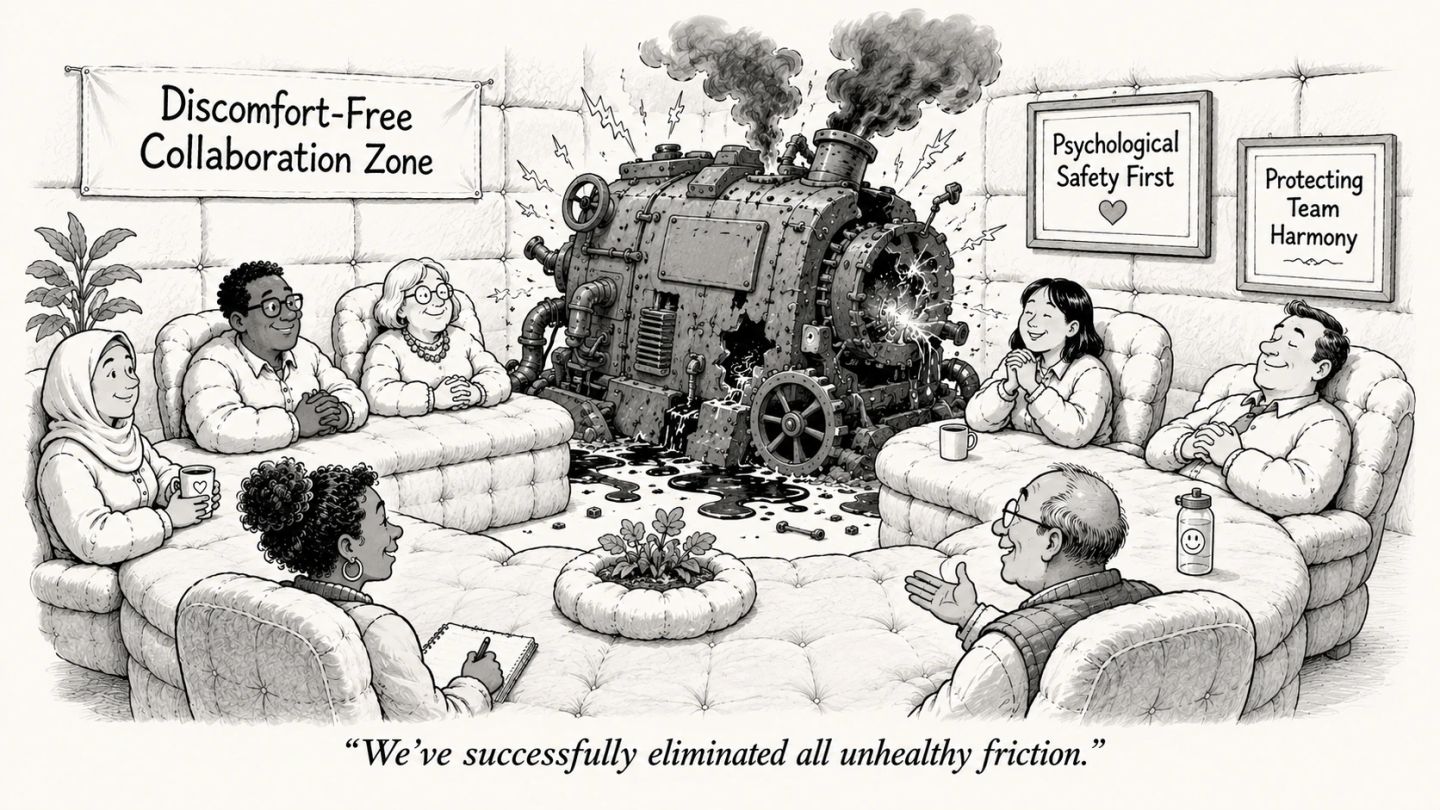
The fine line between psychological safety and coddling
Recently, I was speaking with an executive team that felt stuck. Their engagement scores were in the top decile, and their managers were consistently described as "nice" and "supportive." Yet, no one was fighting for new ideas. No one was challenging the status quo. No one was raging against the broken machine. As a result, work moved too slowly, and their performance had stagnated.
The executives’ first instinct was to double down on what they thought was the cure: more psychological safety. They assumed that if people weren't speaking up, it was because their teams or leaders made them feel unsafe. So they planned more training to make sure that no one felt discomfort.
Any why wouldn't they? After all, the textbook definition of psychological safety is, "the shared belief among team members that the environment is safe for interpersonal risk-taking, such as asking for help, admitting mistakes, or proposing new ideas without fear of punishment or humiliation."
But what if psychological safety wasn't the solution? And worse still, what if what if our best-intended psychological safety interventions caused their problem?
For example, a 2025 survey found that while 86% of professionals feel they "belong" at their company (suggesting a high degree of psychological safety), 76% say they won't actually dissent if they disagree1.
When a culture prioritizes harmony over excellence, it creates a weak environment where intellectual friction—the very thing required for innovation—is seen as a breach of protocol, versus the fun process whereby people sharpen their edges against each other's thinking.
Research from Rice University highlights that firms with excessively strong internal social bonds are actually four times less likely to pursue disruptive innovation than their peers, as the culture becomes too comfortable with the status quo2. Rather than fight for ideas, social relationships suggest you shouldn't rock the boat.
You end up with a team that is too "safe" to win.
Now to be crystal clear, I'm not saying that psychological safety isn't important. There are certainly leaders who create unsafe environments. However, companies that over-diagnose performance problems as psychological safety issues will worsen their performance and motivation.
The motive spectrum: a more precise diagnostic
One of the most common phobias is public speaking. I still remember being a middle schooler terrified of being called in class and asked to read out loud.
And I'm not alone. Approximately 75% of the population experiences some level of fear regarding speaking in front of a group, making it one of the most widespread social anxieties in existence3.
But here's the critical question: When someone is on stage, paralyzed by a dry throat and a racing heart, has the audience created a psychologically unsafe environment? Should the entire audience go to psychological safety training?
Of course not. They were just sitting there. Yet the fear remains.
This little vignette tells you everything you need to know: psychological safety is only one part of a much larger picture of human motivation.
The story of a person's motivation begins with their motives. The motive spectrum organizes the six motives that drive everything we do into a clear framework, as shown in the chart below.

The direct motives—play, purpose, and potential—are driven by the work itself.
- Play is when you do the work because you enjoy the activity.
- Purpose is when you value the work’s impact.
- Potential is when the work enhances your future.
When people experience these, they don't just work; they explore and challenge. Organizations can absolutely systemically create environments that create play, purpose, and potential. Employees will feel psychologically empowered.
Meanwhile, the indirect motives are no longer about the actual work.
- Emotional pressure is tied to your identity and external forces. It is when an external force acts on your identity to compel you to do something. Guilt, shame, peer pressure, or the fear of public speaking mentioned earlier are all examples.
- Economic pressure is driven by external forces (rewards or punishments) that are separate from the work itself, like working only to get a bonus or to avoid being fired.
- Inertia is when the motive is so distant from the work that you can no longer say why you're doing it, other than "that's how we've always done it."
An organization can absolutely systemically create environments that are heavy on emotional and economic pressure. Employees will feel psychologically unsafe.
On the chart above, notice the column between the work itself and the external forces: your identity. When a person's sense of confidence and humility (about their work) is low, they become hyper-sensitized to indirect motives.
A small critique feels like a survival threat. They aren't staying silent because the boss is a tyrant; they are staying silent because they are afraid.
So why aren't your people fighting for performance? There are three distinct possibilities (which could all happen at once):
- Psych Safety (Environment): Actual external threats. Fear of being shamed or fired for dissenting. This is where safety training but more importantly, operating system and habit change, could be important.
- Psych Empowerment (The Work): If the work lacks play or purpose, people don't stay silent because they're afraid—they stay silent because they don't care. Study data confirms that in threatening environments, safety is merely the baseline; it is the feeling of personal empowerment and impact that actually compels an employee to use their voice4.
- Confidence & Humility (The Person): The internal domain. Silence driven by personal identity and past baggage. Leaders often miss that an employee's sense of confidence is a stronger predictor of them speaking up than their actual job security5.
The fundamental managerial error is treating apathy and silence as a lack of safety. When you try to fix an empowerment or confidence problem with more "safety," you accidentally insulate your colleagues when you should be challenging and coaching instead. When you try to fix an apathy problem with more "safety," you signal that even you don't think the work matters that much.
Precision accountability: coaching vs. judging
High performance requires "Intellectual Friction." If safety is the oil that keeps the machine from seizing, then supportive accountability is the gas that actually moves it forward. The mistake of the milquetoast culture is that it tries to run on oil alone.
To break this cycle, leaders must pivot their definition of accountability to the kind a high-performance coach would use:
- Make sure you believe in yourself and know that the coach believes in you too.
- Help you set impactful goals for yourself (see our article on good OKRs).
- Challenge you, and hold you accountable, when you're falling short of your own potential (see our article on supportive accountability).
- Help change the game to help you win (see our article on not blaming the player, but blaming the game).
A 2025 study of thousands of professionals found that when accountability is framed as compliance, it causes exhaustion; however, when framed as an expectation of feedback and excellence, it significantly boosts engagement6.
From comfort to passion
"We argue and debate everything." That is how Tim Cook describes the culture at Apple7. To an outside observer, that might sound intimidating and possibly "psychologically unsafe." But to a high-performing team, it sounds like play and purpose. It sounds like a mission that actually matters.
The mistake most leaders make is acting as guardians of comfort rather that high-performing coaches. When you focus entirely on the "vibe" of the office, you inadvertently signal that the work isn't worth the discomfort of a disagreement. You trade passion for politeness, and in doing so, you invite the very stagnation you were trying to avoid.
So what if you're an organization that has already over-prescribed psych safety that you're boring and bland? Invest in changing and evolving three critical routines:
- Run quarterly Strategy Checks to set motivating and inspiring OKRs that help you challenge your people to do their best work.
- Run quarterly Culture Checks to ensure that you're challenging your people, not pressuring them.
- Run quarterly Skill Checks to ensure you're building a culture focused on creating supportive accountability.
Stop trying to build a room where no one ever feels challenged. Instead, build a culture where Play, Purpose, and Potential are so high that motivation outweighs ego. That is the only way to move beyond a milquetoast culture and start winning again.
Want to lead with intensity without creating fear? Sign up for our newsletter to learn how to run a Culture Check to find your team's real drivers, and a Skill Check to ensure your leaders are coaching for excellence, not just managing for comfort.
About the authors
Lindsay McGregor
Meet Lindsay McGregor, the best-selling co-author of Primed to Perform, and co-founder of Factor.ai and Vega Factor. She's on a mission to build organizations that are AI Native & People First, because, let's be honest, who wouldn't want a world where every company thrives and everyone genuinely loves their career?
Lindsay is a hard-working nerd at heart. She holds an MBA from Harvard Business School and an undergraduate degree from Princeton University. A former McKinsey & Company consultant, she's also a New York City Library cardholder and a science fiction enthusiast.
Today, Lindsay isn't just talking about change; she's making the tools and doing the science needed to ensure everybody has great professional lives. It's safe to say, she's making work work better for everyone.
Neel Doshi
Meet Neel Doshi, the best-selling co-author of Primed to Perform, and co-founder of Factor.ai and Vega Factor. He's dedicated his career to a pretty ambitious goal: creating a future where all companies are high-performing because they're AI Native & People First. Think of it as making work so good, people actually look forward to Mondays.
Neel looks at this challenge through the eyes of an engineer. He earned his engineering degree from MIT and his MBA from the Wharton School. A former Partner at McKinsey & Company, he's also a Kentucky Colonel and a graduate of the Bronx High School of Science. Neel takes science-nerd to all new heights.
Currently, Neel is focused on showing the world that through science and AI, every team and company can be extremely motivating and high-performing. No one need be left behind in the march of progress.
Further reading
- How company culture shapes employee motivation: Learn how to maximize positive motives like play and purpose to build high-performing teams.
- Stop blaming me and calling it "accountability": Discover how to create a supportive chain of accountability that avoids the blame trap.
- Should Wells Fargo have fired employees who were simulating keyboard activity?: An analysis of why surveillance is a poor substitute for effective leadership and performance culture.
- There are two types of performance - but most organizations only focus on one: How to balance tactical and adaptive performance to ensure long-term organizational health.
- ^
- ^Rice University / InnovationMap. Rice Research: Getting Too Comfortable Affects Innovation (2025).
- ^
- ^Creon & Schermuly (2025). Feeling safe to be empowered: Psychological safety and empowerment.
- ^López Bohle et al. (2025). Promoting employee voice: The mediating role of organization-based self-esteem.
- ^Colder et al. (2025). Accountability at Work: Effects on Exhaustion and Engagement.
- ^Lynch, Gabrielle. (2026). "When Steve Jobs Stepped Down From Apple, He Advised Tim Cook to Never Ask Himself This One Question." Entrepreneur.