Don't build a culture to change your habits
Transform your Company Culture by focusing on the small, daily habits that define excellence.
Summary: Culture is the collective sum of a team's habits, not a vague mission statement. Culture Checks provide the mechanism to intentionally design how a team operates by changing daily behaviors. This AI-Native & People-First approach ensures that cultural change is grounded in the actual work, driving measurable improvements in motivation and performance.


Our third name change (and why we're finally happy with it)
At Vega Factor and Factor.ai, we have a maniacal obsession with getting things right. Sometimes, that means admitting we were wrong—three times in a row. We recently renamed one of our most popular features for the third time in its history. What started as a Culture Check became a Culture Check, and has now finally landed on Culture Check.
If that sounds like a branding identity crisis, we promise it isn't. To us, it is intellectual honesty. We were learning in public. When we called it a Culture Check, it sounded too much like a clinical visit—something you do once a year to make sure you aren't, well, unhealthy. When we shifted to Culture Check, it felt more like a chore, a repetitive task to tick off a list. Neither captured the transformative power of what our customers were actually experiencing.
The truth is, we were overthinking it. We were trying to be clever when we should have been clear. We realized that we aren't just checking "health" or "habits" as a side project. We are helping leaders build culture. By renaming the experience, we’re helping leaders learn faster by calling the work what it actually is: the intentional design of how a team operates.
What's funny to me is that the subtitle of Primed to Perform is "How to Build the Highest Performing Cultures..." and we've finally come full circle.
Culture is the "adaptive what"
"Culture eats strategy for lunch." Many managers have heard this quote somewhere along the way. But what does it actually mean?
At Factor.ai, we look at it as a simple math problem. Every team has to manage two types of performance: tactical (how well you stick to the plan) and adaptive (how well you diverge from the plan when it’s no longer working).
Leaders must manage the why, what, and how of work to drive performance. So let's pull this all together.

If you look at the five factors of performance, you’ll see they come in pairs. On the "how" level, you have process (tactical) and skill (adaptive). Process is like cooking a meal with a recipe. Skill is critical to perform even when the recipe isn't quite right.
But the "what" level is where the real tension lives.
The "what" is knowing what you're going to do. It is right between the why and the how. The tactical side of "what" is strategy. Strategy, via OKRs, is the force of aligning what people do.
But what is the adaptive side of "what," the opposite of strategy?
We struggled for a long time to name that box on the right. We tried "health" and "habits," but we finally realized we were describing the very fabric of the organization. Culture.
Strategy is your manual for when things go right. It’s the map. But culture is the plan for when the manual ends and things go wrong. It’s the adaptive what—the invisible set of reflexes that dictate how your team actually solves problems in a Tuesday morning meeting when a customer leaves or a project fails.
Why traditional engagement surveys are often insufficient
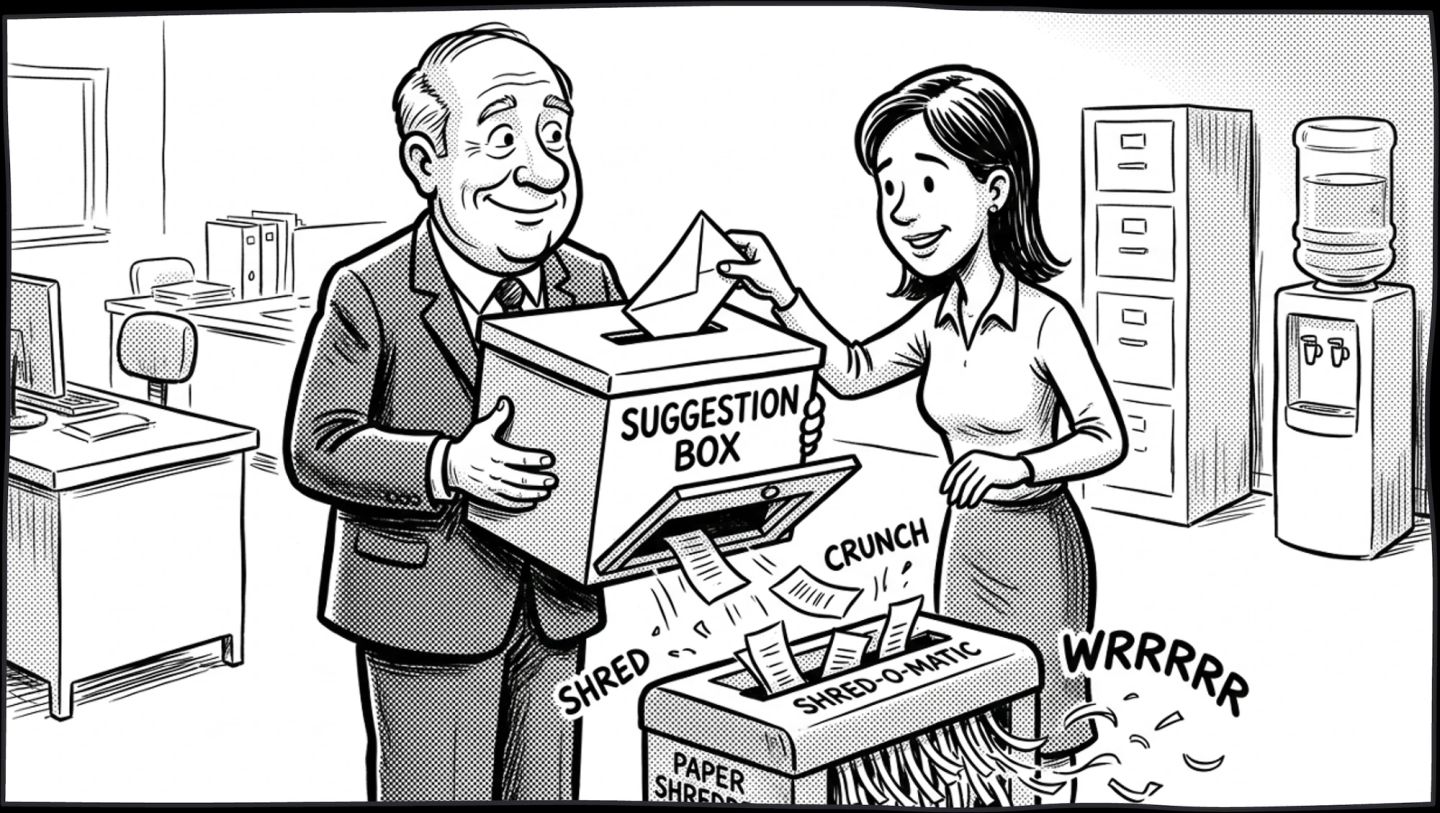
Most engagement surveys suffer from a fatal flaw: they are designed for the person reading the report, not the person doing the work. As a result, often, the annual engagement survey has become a form of performative listening. It creates an illusion of hearing employees, but it lacks the machinery to actually drive change at the team level.
As a result, cultures don't change, or worse. After decades of using engagement surveys, employee engagement is at all-time lows. Companies are clearly flying blind when it comes to their actual performance cultures.
Enter the Culture Check.
Culture Checks are an AI-Native process where teams spend 90-minutes together every 3 to 4 months to identify the biggest bottlenecks and challenges in their performance cultures, and create a plan to improve it. In many ways, Culture Checks are the exact opposite of traditional engagement surveys.
| Category | Traditional engagement surveys | Culture Checks |
|---|---|---|
| 1.Purpose | Monitor (thermometer): Tracks lagging scores like satisfaction or engagement. | Improve (air conditioner): Gives teams the tools and plan to improve their motivation and performance culture. |
| 2.Timing | Events: Annual. | Rhythm: Every three to four months. |
| 3.Focus | Abstract: General feelings about the company or benefits. | The Work: Focused on building high-performing and motivating habits. |
| 4.Ownership | HR-Led: Results are "owned" by executives and HR. | Team-Led: Results are owned by the people doing the work. |
| 5.Agency | Passive: Teams wait for management to "fix" things for them. | Active: Teams have the power to fix their own dynamics. |
| 6.Feedback | Anonymous: Encourages venting and hidden complaints. | Attributed: Encourages honest, professional problem-solving. |
| 7.Structure | Hierarchical: Based on the HR org chart. | Actual: Based on how people actually work (cross-functional). |
| 8.Orientation | Backward-looking: How employees feel about the past, which further primes complaining. | Forward-looking: Anticipating future work and making changes proactively in your team. |
| 9.Speed | Slow: Results take weeks to analyze and report back. | Instant: Results are available for the team to act on immediately. |
| 10.Psychology | Negative: Primes people to look for what’s wrong and lets employees believe that executives have to fix their problems (coddling). | Positive: Challenges people to collaborate on how to get better as a team. |
| 11.Outcome | A Score: Ends with a report or a dashboard. | A Plan: Ends with OKRs and plans to improve the team. |
You can start running Culture Checks today with no training required using the Factor.ai platform. Factor uses artificial intelligence to help a team get to a great outcome from their Culture Checks: one where they actually improve their performance habits.
Culture isn't a vague "vibe" or a mission statement on a wall; those don't solve problems. Culture is the collective sum of your team's habits. When you change the habit, the culture follows.
Don't build a culture to change your habits; change your habits to build a culture.
How to build culture by next Tuesday
The secret to building a high-performing culture isn't a three-year roadmap; it's what your team decides to do differently by next Tuesday. To make this shift, leaders must stop acting as monitors of employee sentiment and start acting as enablers of team habits. When you stop asking, "how do you feel?" and start asking, "what habit is slowing us down?" the path to performance becomes clear.
Start small. Launch the Culture Check process to get your teams used to owning their performance habits.
By integrating these checks into a four-month rhythm, you ensure that culture remains a living part of the work, not a seasonal HR event. This predictable cycle prevents fatigue and turns continuous improvement into the team's natural operating mode. You aren't just checking a box; you are installing a new operating system for how your team solves problems.
In the rapidly shifting world, the teams that win won't be the ones with the best "vibe." They will be the ones that can change their habits together faster than the competition. Culture isn't something you have; it's something you do. Change habits, and the culture will follow.
About the authors
Lindsay McGregor
Meet Lindsay McGregor, the best-selling co-author of Primed to Perform, and co-founder of Factor.ai and Vega Factor. She's on a mission to build organizations that are AI native & people first, because, let's be honest, who wouldn't want a world where every company thrives and everyone genuinely loves their career?
Lindsay is a hard-working nerd at heart. She holds an MBA from Harvard Business School and an undergraduate degree from Princeton University. A former McKinsey & Company consultant, she's also a New York City Library cardholder and a science fiction enthusiast.
Today, Lindsay isn't just talking about change; she's making the tools and doing the science needed to ensure everybody has great professional lives. It's safe to say, she's making work work better for everyone.
Neel Doshi
Meet @Neel, the best-selling co-author of Primed to Perform, and co-founder of Factor.ai and Vega Factor. He's dedicated his career to a pretty ambitious goal: creating a future where all companies are high-performing because they're AI native & people first. Think of it as making work so good, people actually look forward to Mondays.
Neel looks at this challenge through the eyes of an engineer. He earned his engineering degree from MIT and his MBA from the Wharton School. A former Partner at McKinsey & Company, he's also a Kentucky Colonel and a graduate of the Bronx High School of Science. Neel takes science-nerd to all new heights.
Currently, Neel is focused on showing the world that through science and AI, every team and company can be extremely motivating and high-performing. No one need be left behind in the march of progress.