Faux performers are taking over the workplace, but don't blame them
End performance theater by aligning Employee Engagement with genuine impact rather than optics.
Performance theater occurs when organizational systems reward optics over outcomes, creating a rational but wasteful response to indirect pressure. Total Motivation addresses this by replacing emotional and economic triggers with genuine play and purpose. By prioritizing impact over visible activity, this AI-Native & People-First approach transforms bureaucratic theater into a sustainable engine of innovation and growth.


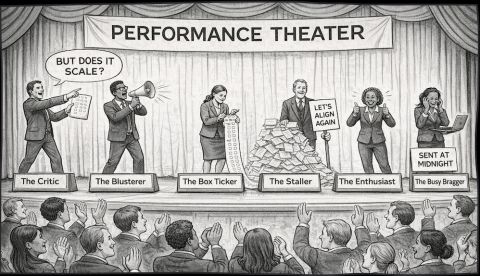
Change the game and get rid of performance theater
Lately, we've been seeing a sharp increase in employees who have multiple full-time jobs.
Think about that for a moment. Sometimes, for years, these individuals have led multiple companies to believe they were working full-time for them.
This trend raises many questions. Why wasn't their progress more closely coached? Why wasn't their lack of engagement a more obvious red flag?
On the flip side, many CEOs are pushing for more intensity and velocity in their organizations. But here's the paradox: these pushes can often result in "faux performance," also known as performance theater.
I've been there myself. I've been a faux performer. And I can tell you, many organizations simply cannot tell the difference. So today, like a magician revealing their tricks, I'm going to expose the art of performance theater. I'll share the tell-tale signs of fake performance, and how you can spot them in your own organization.
My hope is you use this knowledge NOT to blame the player, but instead to blame the game.
Performance theater
The problem of "productivity theater" isn't new, but it's reaching epidemic levels. It's this beautiful artform of seeming competent when, in fact, you might be utterly incompetent. This pervasive issue in modern organizations means visible activity often masks a lack of genuine impact.
Recent studies confirm this. A June 2024 Forbes article highlighted that 79% of employees feel they must engage in some form of performance theater to "show" they are working.
What's even more concerning is how AI is being used. We're often seeing generative AI being deployed to automate productivity theater. This isn't a good thing. It produces more "slop," making it even harder to distinguish genuine high performance from a carefully constructed illusion.
In our work helping to create motivated, high-performing organizations, we've seen six common patterns of performance theater.
Note: all names in the following stories have been changed to protect anonymity.
Using low-value criticism to seem thoughtful but not adding value
The first trick in the faux performer's playbook is a masterclass in sounding thoughtful without actually adding value. I remember Rebecca, a mid-level manager, who had this down to an art. In every strategy meeting, after a proposal was laid out, she'd lean forward and deliver her signature lines: "Yes, but does it scale?" or "Well, okay, but is this consistent with our brand?"
These questions sounded smart. They hinted at a deep, strategic mind. But here's the thing: they were generic. They could apply to almost any initiative, and Rebecca rarely followed up with specific insights or alternative solutions. Her goal wasn't to genuinely improve the proposal; it was to appear engaged and analytically sharp. It was low-risk, high-reward for her image, deflecting attention from any lack of substantive contribution.
Today, we see a remote-work friendly version of this same trick. Rather than vocalizing these questions, they are placed in the comments of a document.
Companies must avoid putting pressure on contribution. Leaders should role model saying, "no notes, this is great." When leaders have real criticism they should explain more deeply their concern and possible solutions. And colleagues should be coached when they engage in intellectual posturing.
Using bluster to seem intelligent but not adding value
Marcus, an experienced individual contributor, was a master of bluster. When faced with a complex problem he didn't understand, he wouldn't ask clarifying questions or ask for help.
Instead, he'd launch into a passionate, jargon-filled monologue, that was devoid of substance. "It would be RIDICULOUS to consider any other option!!" "It's critical that we TAKE THIS REALLY SERIOUSLY!!"
In every meeting he was the human version of an exclamation point. No sentence. Just the punctuation.
Real confidence doesn't come from bluster. It comes from clarity and humility.
Making table stakes behavior look like high performance
The next trick in the performance theater playbook is a classic: making check-the-box behavior look like high performance.
For example, imagine a seller who drafts a performance review talking about all the sales calls they did in the past half-year. They flood their description with detail about these activities, and rely on recent stories to show their value.
That's great, but that's the minimal standard for process-oriented jobs. Moreover, this task-based approach to work could easily result in compliance without impact. The seller completed all their tasks, but still didn't have good risk-adjusted results.
Generally the first three job grades in an organization should be focused on learning and mastering the tactical processes of a person's job.
But eventually, at grades four and above, colleagues should be participating in solving growth problems. The simple starting point is to fix your job grades and levels. More often than not, when organizations ask us to help them, their existing job levels are either too complex, too vague, not up-to-date with the current needs of organizations, not AI-native, and not people first.
Note, above, I described results as "risk-adjusted". This is a critical way for leaders to think about outcomes. It's easier to get low-risk results and hard to get high-risk results. If people are under pressure to just getting "results", they will stop taking risks, and your organization will stop growing. For more on balancing tactical and adaptive performance, see this guide.
Using meetings and memos as stall tactics
The next trick is the stall tactics. I remember David, a department head, who was a virtuoso of this. When faced with a difficult decision or a looming deadline for a task he preferred to avoid, he would immediately schedule a series of "meetings" or request "more analysis."
These meetings would devolve into lengthy discussions that circled the original issue without resolution. The extra analyses he requested were always extensive, requiring significant effort from his colleagues to produce, only for him to "review" them indefinitely.
Inevitably, after about 4 months, there would be a new stakeholder involved (due to a new hire or job rotation). David would use this as an excuse to start aligning all over again. Someone quits? Another excuse. "We can't start until we have someone in this role."
Companies have to be able to spot these stall tactics quickly. This is why we recommend that organizations require their strategy owners to share weekly reflections with their skip-level leadership teams. In these reflections, they should explicitly state if there are any blockers slowing down their progress. Strategy owners need to be transparent about obstacles to execution.
Making it look like you're motivated
The second to last trick in the performance theater playbook is perhaps the most insidious: making it look like you're motivated when you're actually deeply disengaged. I remember Sarah, a colleague who was a master of feigned enthusiasm. Despite feeling utterly uninspired by her work, she maintained a facade of unwavering motivation.
In team meetings, she'd offer effusive praise for new initiatives and volunteer for highly visible but ultimately low-stakes tasks. She consistently used positive, energetic language in her communications. She'd arrive early, stay late, and send emails at odd hours, creating the impression of relentless dedication.
Her colleagues saw a "go-getter," someone always "on." But beneath that surface, her actual contributions were minimal. Her creativity was stifled, and her strategic input was non-existent. The illusion of effort was convincing, but it hid a deep disengagement.
This "go-getter" facade can be hard for leaders to penetrate. It's a survival mechanism in cultures that reward visible effort over real impact. If you want to understand what truly drives motivation, start by looking at the real motives behind the work.
Busy bragging
The final trick in the performance theater playbook is perhaps the most common: busy bragging. You know the type. It's the colleague who's always "swamped," always sending emails at midnight, or sighing dramatically about their overflowing calendar. This is the art of busy bragging.
It's a performative act for an invisible audience, a way to appear overwhelmed to seem important. This behavior is often rewarded in cultures that value visible effort over actual impact. It's a subtle way to avoid deeper accountability, because who can question someone who's clearly working so hard?
The "reply all" email at 11 PM is a classic move. It signals dedication, but often masks a lack of prioritization or even actual incompetence. This constant signaling of busyness can lead to burnout for those genuinely trying to keep up. It also makes others feel inadequate if they're not equally "swamped."
Ultimately, busy bragging is a symptom of a broken culture. It's a distraction from true value creation. Leaders need to focus on outcomes, not activity, and model healthy work-life boundaries. For more on how company culture shapes these behaviors, see this research.
Don't blame the player, blame the game
You've seen the tricks, but here's the critical insight: very few people start a job with the aspiration of faking performance. (Almost) no one wakes up thinking, "Today, I'm going to be a faux performer."
Instead, performance theater is a symptom, not the disease. It's a rational response to a broken system. Organizations inadvertently create incentives that reward optics over outcomes, fostering environments where appearing busy is more valued than actually delivering impact.
This is where the "blame the game, not the player" principle comes in. As W. Edwards Deming, the father of quality management, taught us, most performance problems are systemic. Leaders control the system; employees operate within it.
The management operating system of your organization shapes behavior.
The solution isn't punitive. It's systemic. It's about empowering leaders to change the game. This means designing roles for total motivation (play, purpose, and potential), implementing clear processes for prioritization, delegation, motivation, and apprenticeship, and ensuring everyone has clear expectations. If you want to build a truly high-performing organization, focus on the system, not just the symptoms.
About the authors
Lindsay McGregor
Meet Lindsay McGregor, the best-selling co-author of Primed to Perform, and co-founder of Factor.ai and Vega Factor. She's on a mission to build organizations that are AI Native & People First, because, let's be honest, who wouldn't want a world where every company thrives and everyone genuinely loves their career?
Lindsay is a hard-working nerd at heart. She holds an MBA from Harvard Business School and an undergraduate degree from Princeton University. A former McKinsey & Company consultant, she's also a New York City Library cardholder and a science fiction enthusiast.
Today, Lindsay isn't just talking about change; she's making the tools and doing the science needed to ensure everybody has great professional lives. It's safe to say, she's making work work better for everyone.
Neel Doshi
Meet Neel Doshi, the best-selling co-author of Primed to Perform, and co-founder of Factor.ai and Vega Factor. He's dedicated his career to a pretty ambitious goal: creating a future where all companies are high-performing because they're AI Native & People First. Think of it as making work so good, people actually look forward to Mondays.
Neel looks at this challenge through the eyes of an engineer. He earned his engineering degree from MIT and his MBA from the Wharton School. A former Partner at McKinsey & Company, he's also a Kentucky Colonel and a graduate of the Bronx High School of Science. Neel takes science-nerd to all new heights.
Currently, Neel is focused on showing the world that through science and AI, every team and company can be extremely motivating and high-performing. No one need be left behind in the march of progress.
Further reading
- Should Wells Fargo have fired employees who were simulating keyboard activity? — Why performance theater is so common and what it means for leadership.
- My Employees are Demotivated. What Should I Do? — How to diagnose and fix motivation issues in your team.
- Building high-performing teams with Health Checks — Practical steps to create a high-performing culture.
- It's time to end meeting cultures — Why meetings often hurt more than help, and what to do instead.
- There are two types of performance - but most organizations only focus on one — The difference between tactical and adaptive performance.
Published on May 19, 2026