The six dysfunctions of accountability - and how to solve them with AI
Repair broken Operating Models by using AI to facilitate transparent, system-wide accountability loops.
Accountability breaks down when systems are fragmented and focus on blame. The Agentic Harness solves this by creating transparent, system-wide accountability loops. This AI-Native & People-First approach uses VEGA loops to ensure that every team has the context and feedback needed to own their missions and improve performance in real-time.


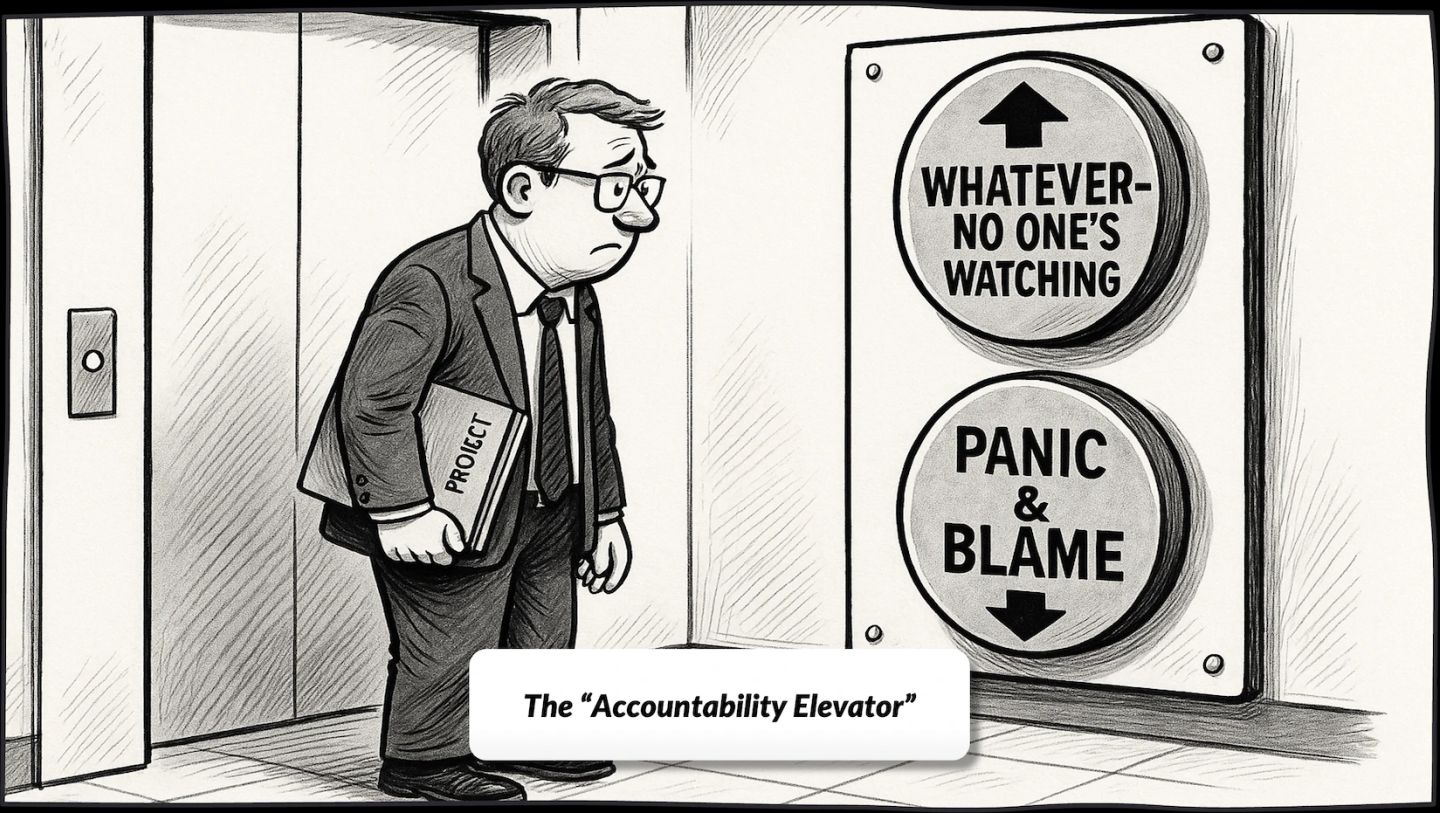
Why is it so hard to create a culture of accountability?
Many organizations are missing the mark on accountability.
Either they are hands-off, allowing a demoralizing complacency to take root, or they are blame-based and high pressure, allowing burnout and toxicity to take root.
However, these aren't the only two options. There is another.

Picture two coaches of professional sports teams.
The first one focuses on accountability for skill building, teamwork, nailing the strategy, and cultivating the right mindset. In other words, all the ingredients of success.
The second focuses on blaming players when they lose and taking credit when they win.
Which coach would you bet on for long-term success? Obviously the first. So then, how can we apply this approach to supportive accountability at the scale and complexity of modern companies?
To do so, companies need to tackle each of the six dysfunctions of accountability:
- Focus on lagging indicators
- Poor expectation setting
- Cross-silo finger pointing
- Expecting everyone to be great at everything
- Slow accountability
- Mistaking team sports for individual sports
The six dysfunctions of accountability
Dysfunction 1 - focus on lagging indicators
In many companies, employees are held accountable for outcomes, but not for having the right inputs. This is a problem for two major reasons.
- First, outcomes are a lagging indicator, so accountability at this point is too late. (If you're playing a sport, the scoreboard of the game is a lagging indicator.)
- Second, when a colleague is held accountable for outcomes alone, they will avoid risk and point fingers. Why would a commission-based sales person want anything but the easy leads? Why would a consultant blamed for outcomes want anything but the easiest projects?
So what actually drives sustainable growth? Where does real improvement come from?
It's quite straightforward, really: growth comes from learning.
- Learning how to serve a new customer segment
- Learning a new marketing strategy
- Learning a new skill
- Learning how to solve a customer problem through technology
Learning is the only sustainable way to improve performance and the universal leading indicator to growth. So why not create accountability for learning?
Let's make this concrete: You're leading a team. You can drive them with goals, but what kind of goals do you use?
- Scenario 1 - "Just do your best." (i.e., the participation trophy approach).
- Scenario 2 - a performance goal, like "grow market share from 7% to 21%." (But... how?)
- Scenario 3 - a learning goal, like "In the next four weeks, experiment with four ways to grow market share from 7% to 21%?"
Which scenario would improve performance the most?
When researchers tested this in controlled experiments, it wasn't even close. The learning goal drove more learning behaviors, higher motivation, and ultimately better performance.

Today, forward-thinking organizations are implementing high-accountability learning goals using AI-powered Strategy Checks.
Strategy Checks are quarterly sessions where teams determine their most important problems to solve over the next three months. Because everyone participates in setting these priorities, they care much more about solving them.

Strategy Checks encourage teams to prioritize problems to solve. This creates a learning orientation at scale.
Teams tap into artificial intelligence as a creative spark, helping them uncover blind spots and find fresh inspiration during their Strategy Checks. Moreover, AI teaches teams how to think like problem solvers, closing the most critical skill gap.

Teams then determine who tackles each prioritized problem using the workFORCE model, which modernizes and fixes the problems with RACI.

Dysfunction 2 - poor expectation setting
Goals with unclear expectations are more likely to create anxiety than accountability. Clarity creates ownership.
To create meaningful clarity in ways that focus on learning velocity, we need to talk through how organizations learn.
Top-performing organizations run on learning loops. These loops require teams to shift between collective work (surfacing) and individual work (diving), and between creative work and execution work.

The first stop in this infinite loop is visioning. This is where teams come together to align on and prioritize the next problems to solve. Think of it as the "what mountain are we climbing?" conversation.
Next comes exploring—the individual work of discovering ideas. This step is figuring out how we should climb that mountain.
These two phases loop until the team has ideas worth executing. That's when the work shifts gears into execution-mode.
The first phase in execution-mode is galvanizing—making sure teams have everything they need to succeed: the right structure, skills, and processes. It's like checking that everyone has clear roles and the right equipment before starting the climb.
And finally, achieving—the individual work needed to execute adaptively. This is the climb itself, where the team still has to solve everyday problems.
Each of these four steps presents unique challenges, which is why creating clear expectations for each step in a VEGA loop is so valuable.
To do so, during Strategy Checks, teams answer four simple questions for each priority:
- For visioning: Is the destination clear, or are do we need to do discovery work to figure it out?
- For exploring: Are we aiming for breakthrough innovation (which could take time and involve risk) or steady iteration (don't reinvent the wheel)?
- For galvanizing: Is our team already set up for success or not?
- For achieving: Should we move fast (and accept some risk) or check in often to make sure we're managing risk carefully?

Here's a bonus insight: when all the choices lean left, you're probably looking at a faster path than if they all lean right. This helps set realistic expectations from the start—no more unexpected "why isn't this done yet?" conversations.
Dysfunction 3 - cross-silo finger pointing
Picture this: you and your team are tackling a problem, but success hinges on whether other teams prioritized the same issue. If they didn't, how excited would you be about taking accountability?
Organizations are ecosystems where everything is connected. Sales teams need good products. Product success depends on effective sales.
To break this dysfunction, Strategy Checks allow teams to share priorities with other teams and request collaboration. If those teams choose different priorities, everyone gets notified and can adjust plans accordingly—no blindsiding, no midnight surprises.

With Strategy Checks, all teams' priorities are transparent. You can always see exactly what your partner teams are focusing on instead of having to ask.
Dysfunction 4 - expecting everyone to be great at everything
Between the two of us, Lindsay thrives when she's galvanizing and achieving. That's her zone of genius. Neel, meanwhile, is in his element when exploring and visioning. Yet early in Neel's career (like most careers), "achieving" was the only currency that mattered. Luckily, Neel had leaders who recognized his strengths didn't match his initial role and helped him bridge the gap until they did.
Too often, companies fire promising young employees who aren't natural achievers. The ironic result? Years later, they wonder why they have no explorers or visionaries in senior roles.
The Factor platform helps teams focus colleagues on what they naturally love by mapping each teammate's play profile.

The further someone's work strays from their play profile, the more they benefit from an accountability partner.
Dysfunction 5 - slow accountability
Great coaches don't wait for annual reviews to provide support, motivation, and discipline. They create tiny moments of accountability in every practice and every play.
In most organizations, managers don't have this luxury—they can't watch their teams work in real-time. So they compensate with endless status update meetings, burning precious time without actually creating an environment for effective coaching.
There's a better approach, and it doesn't involve adding more meetings to your calendar.
After completing their quarterly Strategy Check, the Factor platform asks strategy owners to share brief, written reflections each week. For strategies with multiple owners, they collaborate on this reflection, answering three questions:
- What learnings or impacts did we have this week on this priority?
- Where might we be stuck?
- What decisions were made this week?
Then comes the magic. Factor's AI turns these reflections into weekly "Radar" for each leader, coach, and expert. These guides highlight where their support could make the biggest difference that week. Supportive accountability becomes continuous, with far fewer meetings.
Dysfunction 6 - mistaking team sports for individual sports
I recently asked high-school quarterback phenom Sean Carnevale how team performance affects the college prospects of star players. What happens if a brilliant player is stuck on a lousy team? Carnevale's answer surprised me: college scouts are remarkably adapt at evaluating a player's skills independent of their team's overall performance.
Skill-based performance management and compensation work the same way—focusing on individual merit without penalizing team efforts or risk-taking. In this system, people are assessed on their actual skills.
The Factor platform, for instance, helps colleagues choose skills to improve from a library of over 130 inspiring skills—not vague competencies like "be more strategic" or "show leadership."

Make accountability motivating and effective
For 30 years, we've researched what it takes to build sustainably high-performing organizations. We envision a world where people work together in ways that bring out their best—where everyone has a genuinely motivating job. We wrote Primed to Perform to show that this future isn't just some management fantasy—it's entirely achievable.
But getting there requires fixing our broken accountability systems. Blame-centered or pressure-cooker accountability doesn't work—it's why workplace engagement scores remain in the basement and burnout rates are through the roof. Organizations now have the tools to implement supportive accountability mechanisms that actually work.
So what are you waiting for? Unless you enjoy those awkward conversations where everyone's thinking "whose fault is this?" but no one's saying it out loud.
About the authors
Lindsay McGregor
Meet Lindsay McGregor, the best-selling co-author of Primed to Perform, and co-founder of Factor.ai and Vega Factor. She's on a mission to build organizations that are AI Native & People First, because, let's be honest, who wouldn't want a world where every company thrives and everyone genuinely loves their career?
Lindsay is a hard-working nerd at heart. She holds an MBA from Harvard Business School and an undergraduate degree from Princeton University. A former McKinsey & Company consultant, she's also a New York City Library cardholder and a science fiction enthusiast.
Today, Lindsay isn't just talking about change; she's making the tools and doing the science needed to ensure everybody has great professional lives. It's safe to say, she's making work work better for everyone.
Neel Doshi
Meet Neel Doshi, the best-selling co-author of Primed to Perform, and co-founder of Factor.ai and Vega Factor. He's dedicated his career to a pretty ambitious goal: creating a future where all companies are high-performing because they're AI Native & People First. Think of it as making work so good, people actually look forward to Mondays.
Neel looks at this challenge through the eyes of an engineer. He earned his engineering degree from MIT and his MBA from the Wharton School. A former Partner at McKinsey & Company, he's also a Kentucky Colonel and a graduate of the Bronx High School of Science. Neel takes science-nerd to all new heights.
Currently, Neel is focused on showing the world that through science and AI, every team and company can be extremely motivating and high-performing. No one need be left behind in the march of progress.
Learn more
- Stop blaming me and calling it "accountability"
Discover how to create a culture of accountability that motivates rather than blames. Learn to focus on motivation, habits, and supportive coaching to foster a high-performing environment. - Blame is why your culture is low-performing
Unpack the destructive nature of blame in the workplace and explore how to shift towards supportive accountability. Understand the systemic issues that hinder performance and how to address them. - How company culture shapes employee motivation
Dive into the science of motivation and how company culture can make or break it. Learn about the six primary motives for work and how to cultivate a culture that enhances performance.