The 10-minute coaching script to help your team set impactful OKRs.
Empower your managers to lead better with a simple Coaching & Feedback script for OKRs.
Managers often struggle to coach for strategy, falling back on task-based checklists instead. Supportive accountability is facilitated through a simple five-question coaching script that evaluates OKR impact. This AI-Native & People-First approach empowers leaders to use Weekly Reflections as a tool for deepening their team's strategic thinking and problem-solving capabilities.


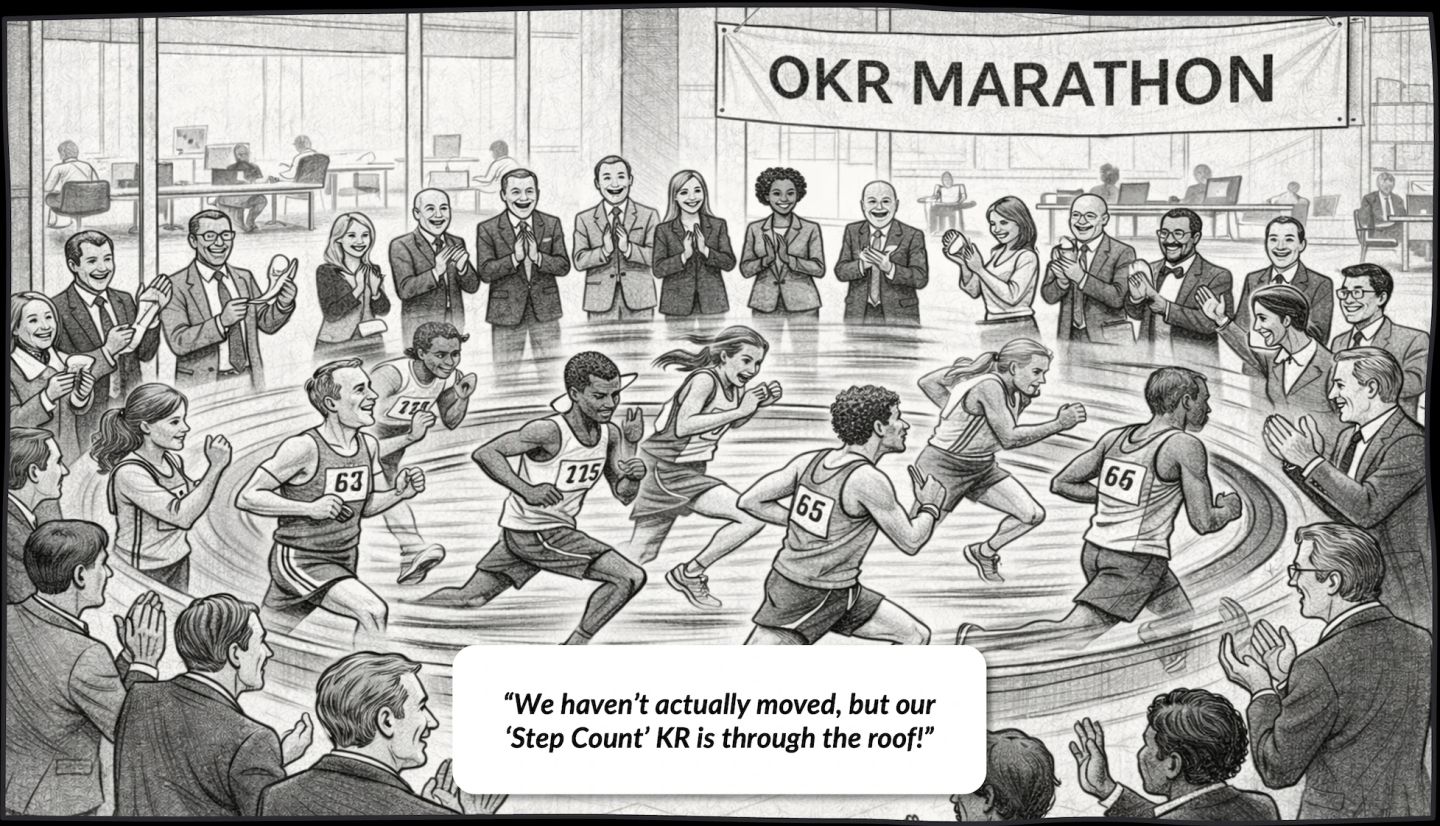
One of the most important jobs of leaders is to help their colleagues set good OKRs. But this coaching work is surprisingly difficult to do. This article is a practical guide to coaching your teams on the OKRs they plan to set.
When you're coaching a subordinate on whether or not their OKR makes sense, follow this five-question guide:
- Coaching question 1: Is the objective a problem to solve?
- Coaching question 2: Is this the right kind of OKR given the needs of the organization?
- Coaching question 3: What's missing?
- Coaching question 4: Are the key results right?
- Coaching question 5: Bonus: Are all the expectations right?
Coaching question 1: Is the objective a problem to solve?
What is the core problem this OKR is solving, and do you agree this is the right problem to focus on?
If your team's OKRs sound like a to-do list, you aren't coaching. You're just supervising a checklist. To be an effective coach of OKRs, you need to help each colleague solve their underlying problem.
To be a strategic coach, you should make sure the objective describes a problem to solve, not a project or deliverable to finish.
The "so what?" test
The simplest way to diagnose an OKR whose objective is just a task is to ask: "If the team completes this OKR perfectly, is there still a good chance there's no impact?"
If the answer is yes, you have a task. Tasks create a checkbox mentality where the team feels successful because they were busy, even if the business is failing. These give rise to "obfuscation labels"—vague project names like "Project Orion" or "Q1 Marketing Plan" that hide the actual problem and prevent good coaching.
| Weak, task-based Objectives | Better, problem-based Objectives |
|---|---|
| Launch the Q1 Referral Program. | How might we lower our cost of acquisition and improve lead quality by encouraging customers to refer other customers? |
| Project Omega | How might we optimize our agentic search capabilities so our customers can more frequently find exactly what they are looking for? |
| Hire 3 new account executives. | How might we grow our sales capacity so we can decrease our time to first interaction, time to close, and sales cycles times? |
Why this matters for the 5-minute script
When you coach a problem, you can ask about friction and learning. When you coach a task, you are forced to ask about status updates.
By forcing the objective to be a problem, you give your team the space to pivot their tactics if the first deliverable they try doesn't work. You are no longer responsible for "how" the work gets done; you are only responsible for architecting the "what" and the "why."
Coaching question 2: Is this the right kind of OKR given the needs of the organization?
Imagine two organizations: one that is at a performance plateau versus one that is in hyper-scale mode. Based on just this, you'd expect a very different portfolio of OKRs.
So to coach an OKR effectively, you need to first know what type of OKR it is. In this step, look at your colleague's OKR and ask yourself, "what kind is it?" Then test whether or not that type is suitable for the moment your company finds itself in.
There are four types of OKRs, defined by two dimensions.
Dimension 1: Working forward vs. Working backward
OKRs should always focus on performance improvement, but the direction of that improvement changes based on your starting point.

Operational OKRs are working forward from your current state. For example, today your team can take 500 calls per day, and you're planning to make some tweaks to get them to 510 calls per day. These are about continuous improvement (i.e., BAU).
When an organization has a lot of scale momentum (e.g., it found product-market fit and is penetrating its core segment fairly quickly), you'd expect to see more Operational OKRs. Why? Because as you're scaling, there's a lot of low-hanging fruit and simple changes that could have a significant impact.
Strategic OKRs are working backward from your future state. For example, we envision that in the future, we'll use AI for most of our calls, and our call team will primarily be responsible for handling exception calls and curating AI context. That future is not one that comes from simple tweaks to our current state. To get there, one has to work backward from that vision. For example, the next OKR might be around how we might establish meaningful (can learn from) AI pilots for call taking?
When an organization is either at a performance plateau or suddenly experiencing a new market force, you'd expect significantly more Strategic OKRs.
Dimension 2: Top-down vs. bottoms-up
A team can prioritize improvement that solves for a local optimum. Local optimums are about optimizing the team's performance independently of anything else going on in the organization. These kinds of OKRs are called "local".
On the other hand, a team can prioritize improvement toward a global optimum. A global optimum is about optimizing the performance of the whole organization. Sometimes this might imply "taking one for the team" or, in other words, a team sacrificing some of its own performance at the expense of the whole. A product team solving for transparent collaboration with the go-to-market team might be sacrificing a bit of their own performance for the sake of the whole. These kinds of OKRs are "global".

Teams will most often bias toward "bottom up" and "working forward from the current state", which are Type UF OKRs.
The four types of OKRs
Given all of this context, for coaching question 2, you should understand what kind of OKR your subordinate is considering, and then based on it, there's a set of questions you should ask:
| OKR Type | About this type | Key coaching question |
|---|---|---|
Operational local OKRs Example: Ticketing Efficiency: Reducing response time from 4 hours to 2 hours to alleviate team burnout. |
| Are we certain that we shouldn't be working backward from a future vision, or toward a top-down objective? |
Operational global OKRs Example: Retention Alignment: Reducing churn by 5% to meet Q4 targets by optimizing our current renewal sequence. |
| Is this problem really the best way to spend our time? |
Strategic local OKRs Example: Proactive Partnership: Launching a "Value-Realization" workshop series to shift from support to "Strategic Advisors." |
| Is this OKR focused on testing your vision as fast as possible? If other teams or functions did not work on this vision, can you still succeed? |
Strategic global OKRs Example: Building our new business: Altering our brand messaging to support our next-generation value proposition. |
| Is this OKR really the right way for this team to contribute to the broader organization's vision? Is this OKR focused on testing the organization's vision as fast as possible? |
Coaching question 3: What's missing?
Decent coaches coach their team on type I error. Type I error is when they are making mistakes. Great coaches also coach their team on type II error. Type II error is when your team is missing something or has a blind spot.
So for coaching question 3, look at your subordinate's OKRs and ask yourself and them, "what's missing?"
Generally, if their OKRs are local, the most common misses are OKRs that are critical to support the organization's broader objectives.
Coaching question 4: Are the key results right?
There are a few common problems with KRs. Imagine you have an OKR like:
How might we iterate toward product market fit for our new tool rental service? What would be good KRs for this? There are a handful of common problems when setting KRs.
| Common KR problems | Example |
|---|---|
| The KRs don't actually capture the impact of that specific OKR. | Market share growth of 7%. This might not make sense if the objective is focused on establishing product-market fit. |
| The KRs are limited to existing or permanent measurements. | Repeat website visits. Perhaps this is an easy-to-capture measurement, but does it really test whether or not we've achieved product-market fit? Instead, the KRs should likely be tests of that product-market fit (e.g., customer interviews that express fit). This metric may not be a permanent one, and it is just established for this OKR. |
| KRs are task milestones. | Next product iteration released by 4/1. Milestones are very useful as part of an OKR's definition. We recommend including them. But they are not key results. |
For this step, validate that the KRs are genuinely impact-oriented.
Coaching question 5: Bonus: Are all the expectations right?
If you made it to question 5, you're coaching at a significantly higher level than most leaders. So if you're up for taking it to the very next level, there are four expectations that are valuable to understand when you're reviewing your subordinate's OKRs:
| 5A: Who is the workFORCE? | 5B: What are the problem solving guardrails? | 5C: When do you believe we'll see enough impact to know if this will work (or not)? | 5D: What are the milestones? |
|---|---|---|---|
| FORCE Use the FORCE! For each OKR who are the: Followers Owners Reviewers (e.g., steering group) Coach (i.e., owner's boss) Experts (i.e., working team) | For each OKR: Discovery needed? Do we need to do discovery work to solve the problem or jump straight to execution? Iterative approach or innovative approach? Plan for change management? (i.e., will behavioral change be needed to achieve impact?) Go fast vs check-in-often (i.e., and wait for consensus) | This question is critical to ensure we are able to learn fast and pivot fast if needed. | The planning milestones are when we expect critical deliverables to be done. The milestone approach is quite telling. For example, iterative work might be focused on the quantity of experiments (e.g., by 4/1 we'll have run 12 experiments). |
The bonus questions above really help form a rock solid expectation for OKRs.
Conclusion: from interrogation to intervention
The transition from a task-centric leader to a strategic coach is the single highest-leverage move a manager can make. By matching your coaching language to the OKR’s vector, you remove the bureaucratic atmosphere that kills team motivation.
Keep this script open. Start your next review with a problem, not a checklist. Your 10 minutes start now.
Bonus: Advanced practice
Now, if you're ready for an even more effective practice, run Strategy Checks with your team every quarter.
Strategy Checks are a shared process where leaders and their colleagues answer ALL these questions together (as a team) in four hours, ultimately concluding with aligned OKRs. You can use the Factor.ai platform to help you run these Strategy Checks. AI helps teams with the most challenging steps to help them with blind spots and learn new skills. AI also helps synthesize all these answers to draft a great OKR.
When you use a Strategy Check, in record time, and through real collaboration, your team will produce OKRs like this:
OKR - OPERATIONAL TRANSFORMATION: 50% Process Optimization
Objectives (i.e., the problems to solve)
- This is a Strategic problem. Our Finance team is currently hindered by high levels of manual data analysis and routine reporting that consume over 50% of team capacity. This prevents us from acting as Strategic Architects or upskilling for the future vision of the department.
- Deeper Root Causes:
- Discovery Gap: We lack a centralized, quantified inventory of which specific BAU activities are the biggest "time-thieves" across our global offices.
- Capacity Paradox: Teams are too busy with manual work to find the "protected time" required to learn the AI and automation tools needed to reduce that same manual work.
- Structural Readiness: Our current systems and team skill sets aren't yet fully equipped to transition from manual execution to AI-powered oversight.
Key results
- 50% reduction in total hours spent on monthly reporting and routine data processing by the end of Q3.
Impact timing
- When we expect to see enough impact to know if we should pivot or keep going: End of Q3
Problem solving guardrails:
- Visioning - Our direction needs discovery: We need to figure out the right path for automation.
- Exploring - Innovation-focused: We primarily need bold, high-leverage ideas that drive breakthroughs.
- Galvanizing - Not yet fully equipped: We currently lack some of the systems or structures needed to succeed.
- Achieving - Execute deliberately: Build consensus and alignment across functions before moving forward.
Milestones
- Completion of the BAU "Process Inventory" and effort-impact mapping.
- Presentation of Discovery findings and automation roadmap to Sarah for alignment.
- Execution and review of the first "Bold Innovation" AI pilot for report automation.
- Mid-point Culture Check to assess workload sustainability and protected learning time.
WorkFORCE
- Owners: Alex Chen, Maria Garcia, David Okoro
- Coaches: Sarah Jenkins, Marcus Thorne
- Experts: Elena Rodriguez
- Followers: James Wilson
- Reviewers: Linda Zhang
About the authors
Lindsay McGregor
Meet Lindsay McGregor, the best-selling co-author of Primed to Perform, and co-founder of Factor.ai and Vega Factor. She's on a mission to build organizations that are AI Native & People First, because, let's be honest, who wouldn't want a world where every company thrives and everyone genuinely loves their career?
Lindsay is a hardworking nerd at heart. She holds an MBA from Harvard Business School and an undergraduate degree from Princeton University. A former McKinsey & Company consultant, she's also a New York City Library cardholder and a science fiction enthusiast.
Today, Lindsay isn't just talking about change; she's making the tools and doing the science needed to ensure everybody has great professional lives. It's safe to say, she's making work work better for everyone.
Neel Doshi
Meet Neel Doshi, the best-selling co-author of Primed to Perform, and co-founder of Factor.ai and Vega Factor. He's dedicated his career to a pretty ambitious goal: creating a future where all companies are high-performing because they're AI Native & People First. Think of it as making work so good, people actually look forward to Mondays.
Neel looks at this challenge through the eyes of an engineer. He earned his engineering degree from MIT and his MBA from the Wharton School. A former Partner at McKinsey & Company, he's also a Kentucky Colonel and a graduate of the Bronx High School of Science. Neel takes science-nerd to all new heights.
Currently, Neel is focused on showing the world that through science and AI, every team and company can be extremely motivating and high-performing. No one need be left behind in the march of progress.
Further reading
- Is everyone fit to lead? - Transforming individual contributors into effective leaders to drive team returns.
- Why do most strategic goals fail? - Understanding the strategy and levers that ensure corporate goals succeed.
- Building high-performing teams with Culture Checks - How structured diagnostics improve team motivation and retention.
- The problem with performance management - and how to fix it - Moving from endless meetings to high-frequency feedback loops.