How to fix a culture of complacency
Re-energize stagnant teams by infusing your Employee Motivation strategy with high-frequency feedback loops.
Summary: Complacency sets in when teams lack high-frequency feedback and a clear connection between their work and its impact. Total Motivation provides a five-step plan to re-energize stagnant cultures by managing direct and indirect motives. This AI-Native & People-First approach uses triannual Checks to ensure that teams remain challenged and supported in their growth.


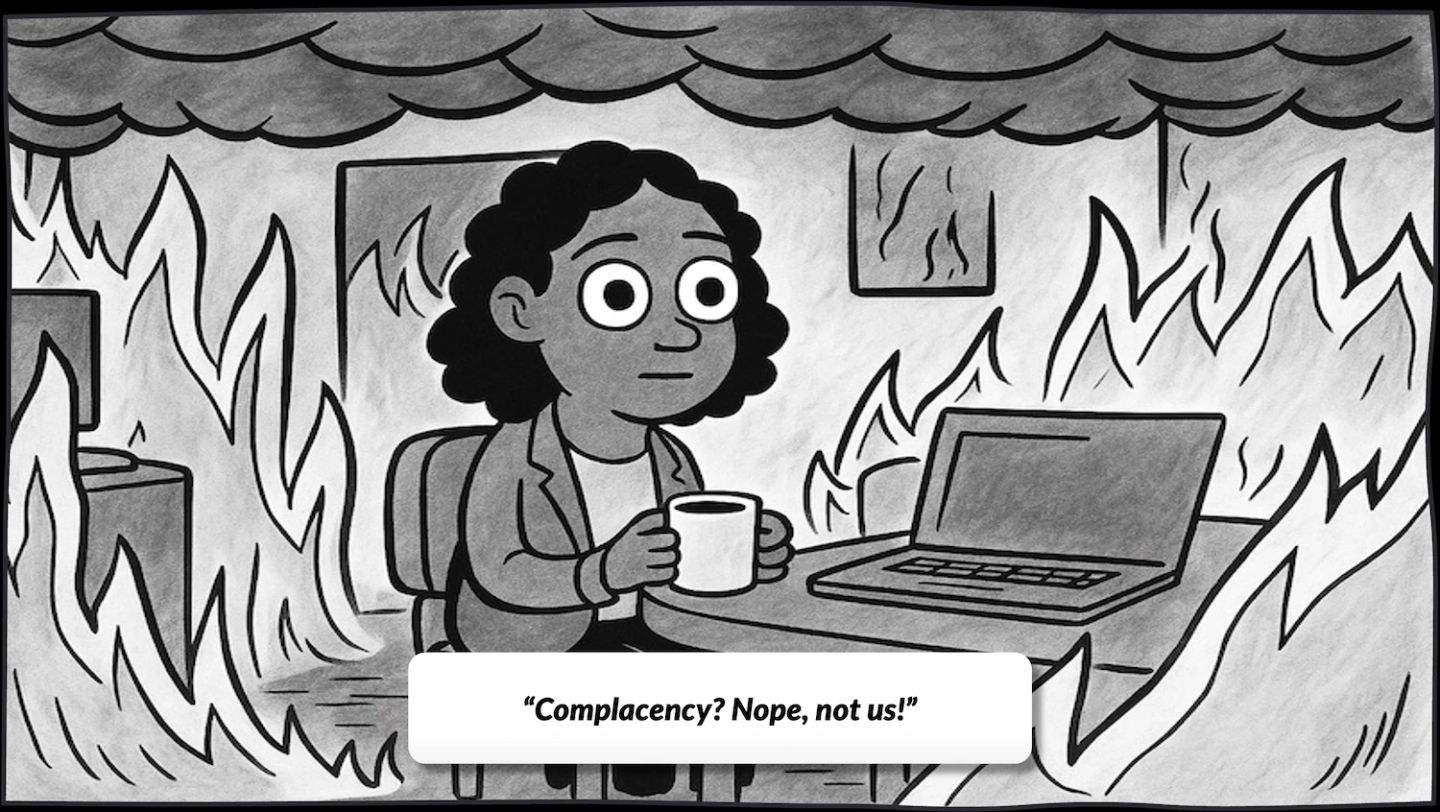
A few days ago, we were working with the founder and CEO of an interesting tech company. He shared that fifteen years in, he's finding his organization has become "complacent." Beyond this discussion, I've been hearing many leaders describe their organizations as complacent.
So, what is complacency really, and how do we fix it?
What is complacency?
Complacency is when you stop striving to improve because you’re comfortable with how things are - even if they’re not as good as they could be.
It’s a kind of false satisfaction that dulls urgency or curiosity. Teams become complacent when they:
- Assume past success guarantees future success
- Stop noticing or acting on problems
- Avoid feedback or challenge
- Choose comfort over growth
Put differently, complacency is performance without adaptability.
Leaders who aim to be high-performing must drive two types of performance, not one. The first is called tactical, and the second is called adaptive. In the worldwide bestseller, Primed to Perform, we describe both in detail.
- Tactical performance is about following processes, policies, plans, and best practices. Tactical performance tends to create scale and allows people to focus less on unimportant work steps.
- Adaptive performance is about NOT following processes, policies, plans, and best practices. Instead, it is about figuring things out, problem-solving, and experimenting. Adaptive performance is how we improve by learning something new.

To achieve the highest levels of performance, an organization needs both. However, they are definitional opposites. Overly increasing one destroys the other. Too much convergence destroys divergence, and vice versa. That's why it is challenging to lead performance at scale.
In a team that is complacent, almost certainly you're getting tactical performance. They are completing their tasks and following their policies, but that's it. It's the adaptive performance that's missing.
The cure to complacency is motivation
In many organizations, people know they need to perform, or they might lose their jobs. So why would someone ever become complacent? It shows you that motivation is more complex than many leaders think.
Motivation comes down to a simple rule: why people work determines how they work. Their reason for their work drives their performance. We've covered this topic in other articles, so I'll briefly recap the reasons why people do things:
Reasons that increase adaptability:
- Play - You do something because you enjoy it. Play is often extinguished when change, curiosity, and problem-solving are either discouraged or feel so difficult and painful it isn't worth it.
- Purpose - You do something because you believe your contribution is important right now. Purpose is extinguished.
- Potential - You do something because it leads to longer-term outcomes you care about. Potential is extinguished when an organization feels rudderless.
Reasons that decrease adaptability:
- Emotional pressure - You do something to avoid looking bad to others.
- Economic pressure - You do something to avoid a punishment or get a reward.
- Inertia - You don't know why you're doing something.
When a team is showing complacency, they are demotivated. They have lost their play, purpose, and potential, and instead are driven by emotional pressure, economic pressure, and inertia.
So, what do we do to fix this, and what can we do fast?
The fastest way to re-energize an organization, in 5 steps
Because complacency is the lack of adaptability, complacent organizations resist change, including the changes that would make them not complacent. Given that complacency resists change, how can an organization effectively intervene? Here are five steps to rapidly re-energize your team:
Step 1: Don't blame the player. Blame the game.
Attacking complacency is like running up a down-escalator. If you run too slowly, you'll never finish because the escalator keeps moving you down. So, to solve complacency in your organization, you want to move fast.
The first step is to enlist your organization in change. Start by teaching your organization the science of performance, so they can make sense of how the systems and ways of working around them can profoundly shape their motivation. They will feel understood without being blamed or attacked. And many change champions will start to make themselves known.
One simple way to do this is to organize a Primed to Perform book club. We can share with you our discussion guides, and you can use them to enlist your people.
Alternatively, feel free to contact us, and we can share alternatives, including one of our mind-blowing keynote talks, delivering actionable insights and inspiring new approaches to performance.
Once that's done, the next step is to rebuild your critical accountability loops.
Step 2: Create accountability for problem solving with Strategy Checks
The first most likely reason an organization becomes complacent is when solving a problem becomes too difficult. This happens for many reasons:
- Too hard to find or absorb the right context.
- Too hard to prioritize.
- Too hard to make a decision.
- Too hard to align across teams.
- Too hard to come up with a useful idea.
- Too hard to figure out what risks an organization would accept.
- Too hard to agree on the problem we're solving.
In this second step, your organization should fix all seven of these issues in one shot. The way to do that is through quarterly and weekly habits.
Every four months, each team should complete a Strategy Check.
Strategy Checks, powered by the Factor.AI platform, are a simple yet powerful technique where teams align on the problems they will solve to drive growth and performance in the next quarter. This leads to faster decision-making, reduced rework, and a clear path to growth that reignites team purpose. They are a powerful antidote to complacency because they are focused on making problem-solving and growth easier. For example, one organization, a mid-sized financial firm, saw a ~50% reduction in time spent on quarterly alignment after implementing Strategy Checks.
Once the Strategy Checks are complete, teams continue to use Factor every week to share Weekly Reflections on their problems, goals, and priorities. Factor's powerful AI then gives every person in the organization the information they need to make decisions, advance their problems, and maintain alignment.
Step 3: Measure motivation and team habits
The second main driver of complacency is when a colleague's team isn't run very well - or in other words, it doesn't have good habits. To solve this, run a second triannual accountability loop, known as a Culture Check.
In a Culture Check, each team spends 90 minutes each quarter identifying how they can improve their own habits. Factor.AI conducts a diagnostic with the team and immediately provides an AI-generated report that helps the team constructively improve itself.
Factor's Culture Checks are a powerful, low-bureaucracy way to keep a team motivated and performing.
Step 4: Create accountability for apprenticeship
The third major driver of complacency is a sense of personal stagnation - when a colleague feels like there is no more growth for them personally.
Obviously, everyone can grow. There's no shortage of skills to improve. The hard part is identifying them and then apprenticing them.
So, the third major accountability loop to build is apprenticeship.
Every four months, colleagues should conduct a Skills Check with their leader. The Skills Check, facilitated by Factor.AI, uses a powerful AI guide to help colleagues identify what skills to focus on.
Skill Checks are a revelation for both leader and learner. As one leader shared with us, "I used to be anxious for weeks prepping to make sure my 1-on-1s went well. Skill Checks take all the stressful prep work out of it so we can focus on having an impactful conversation."
Skill Checks use AI to make it easy and fun to help a colleague improve themselves.
Step 5: Measure the system
"What you measure signals what you value."
To ensure that every team is practicing the right set of complacency-busting habits, you have to measure them. It is critical to know which teams are struggling and which are thriving.
For example, when you use Factor to drive your organization's motivation and performance, you will see for each team how fast they are going, whether they're slowing down or speeding up, how their motivation is trending, what habits they want to improve, and other leading indicators of performance. This makes coaching and unblocking much easier.
It doesn't take long
We've been researching and applying the science of motivation and performance for almost 30 years now, all to get to this point - an easy way for any organization and any team to drive themselves the right way.
At this point, the fix is easy. So take the time this year to transform your complacency culture.
Ready to transform your culture? Schedule a demo of Factor.AI today to see how our solutions can re-energize your organization and drive sustained high performance.
About the authors
Lindsay McGregor
Meet Lindsay McGregor, the best-selling co-author of Primed to Perform, and co-founder of Factor.ai and Vega Factor. She's on a mission to build organizations that are AI Native & People First, because, let's be honest, who wouldn't want a world where every company thrives and everyone genuinely loves their career?
Lindsay is a hard-working nerd at heart. She holds an MBA from Harvard Business School and an undergraduate degree from Princeton University. A former McKinsey & Company consultant, she's also a New York City Library cardholder and a science fiction enthusiast.
Today, Lindsay isn't just talking about change; she's making the tools and doing the science needed to ensure everybody has great professional lives. It's safe to say, she's making work work better for everyone.
Neel Doshi
Meet Neel Doshi, the best-selling co-author of Primed to Perform, and co-founder of Factor.ai and Vega Factor. He's dedicated his career to a pretty ambitious goal: creating a future where all companies are high-performing because they're AI Native & People First. Think of it as making work so good, people actually look forward to Mondays.
Neel looks at this challenge through the eyes of an engineer. He earned his engineering degree from MIT and his MBA from the Wharton School. A former Partner at McKinsey & Company, he's also a Kentucky Colonel and a graduate of the Bronx High School of Science. Neel takes science-nerd to all new heights.
Currently, Neel is focused on showing the world that through science and AI, every team and company can be extremely motivating and high-performing. No one need be left behind in the march of progress.
Learn more
- Three ways to build a culture that lets high performers thrive: Discover how to shift your focus from controlling low performers to nurturing high performers. Learn strategies to reduce unnecessary meetings, measure motivation, and mentor top talent.
- How company culture shapes employee motivation: Explore the profound impact of company culture on motivation and performance. Understand the six primary motives for work and how to foster a high-performing culture.
- Blame is why your culture is low-performing: Unpack the detrimental effects of blame in the workplace. Learn how to shift from a blame-based culture to one that supports motivation and systemic improvement.