Fixing broken Product organizations (B2B edition CEO's guide)
Evolve your Operating Models to solve prioritization hell and restore product development velocity.
Prioritization hell and risk aversion are systemic issues that stall product velocity. Supportive accountability suggests changing the underlying operating model to focus on customer missions. This AI-Native & People-First approach uses the VEGA Loop to design product organizations that are adaptive, motivating, and capable of enterprise-scale innovation.


Why your smart B2B Product team isn't delivering
If you're a CEO or senior executive, which function in your organization do you think performs the worst?
Among the B2B CEOs we work with, the most common answer, by far, is their Product organizations, especially if they need to build software.
Naturally, it's easy to blame the player, assuming it must be their talent (which it could be), but when you see this pattern across so many companies, maybe we need to blame the game.
In this article, we're going to unpack five common reasons why Product Management struggles in B2B companies, and why understanding these systemic issues is the first step to changing the game for good:
- No unique source of insight to own the vision
- No time to form that insight
- Harder to manage risk and thus feels more risk averse
- Harder to get adoption through a B2B Salesforce than through Product-led growth channels
- Can't easily focus on ICPs
Why does your B2B Product team struggle to own the vision?
In B2C organizations, Product teams often have direct access to millions of user data points or, at the very least, easy access to other forms of user research. This gives the Product team a unique source of insight.
The word "insight" is both critically important and often misunderstood. Think of insight as a valuable idea that others don't already have—a better explanation or a solution to a problem. In high-performing organizations, influence (and motivation) comes from insight.
In B2B organizations, it's often hard for Product Managers to get that kind of insight. Sample sizes are too small or not homogenous. The Sales team or Account Executives have a lot of insight from client conversations and RFPs. Implementation or Customer Success teams have insight from on-the-ground visibility.
But for a B2B Product Manager? Where is their insight coming from?
If they don't have a form of insight, it's hard to have a strong opinion. Without a strong opinion, it's hard to have a vision or build a roadmap. Instead, roadmaps get built in more ad hoc ways by requests from every corner of the company. Product Managers end up feeling like project managers, not strategic leaders.
Is your Product team stuck in "prioritization hell"?
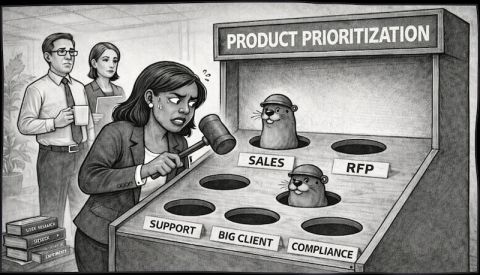
If your Product team feels like they're constantly reprioritizing, drowning in memos and meetings, and never quite getting ahead, they're likely caught in "prioritization hell."
This is a direct symptom of the vision vacuum—a vicious cycle that starves them of the time needed to form real insight. It's like playing Whack-a-Mole with your roadmap: you hit one priority, and two more pop up from different stakeholders, leaving you exhausted but not really moving forward.
This constant firefighting means Product Managers lose the lost art of deep work. They're so busy mediating conflicts, justifying decisions, and writing endless memos that there's no time left for the quiet, focused thinking needed to truly understand customer problems or market trends. The bureaucracy black hole sucks up all their energy, turning strategic leaders into glorified traffic cops.
What's the real cost of this prioritization hell? It's the opportunity cost of innovation—the new products and market leadership you're missing out on because your smart people are stuck in a reactive loop.
How does B2B's unique risk profile stifle innovation?
In B2B, every customer can represent a lumpy chunk of revenue, making the thought of losing even one a terrifying prospect. This unique financial reality often pushes Product teams into a defensive posture, where minimizing risk replaces managing risk. Innovation is killed before it even starts.
Think about it: if one client accounts for 5% of your annual revenue, how much risk are you willing to take with them?
This isn't just about losing revenue; it's also about the political capital and job security of the leaders responsible for those large accounts. Imagine a Product Manager proposing a bold new feature. It could unlock massive value for 90% of the customer base, but it might require retraining for a key client's 500 users. What happens? Often, that bold idea gets shot down.
This constant fear leads to a lowest common denominator strategy. Features are designed to offend no one, rather than to truly delight anyone. Companies delay crucial Product updates for months because one major client threatens to churn over a minor UI change.
As a result, it feels like Product teams are not performing, but this would be an unfair characterization.
Why is Product adoption so challenging in B2B?
Imagine trying to drive a car by giving instructions to a dozen different drivers, all with their own opinions and routes. That's often the reality for B2B Product teams trying to achieve adoption. Unlike B2C's direct channels, B2B's people-led adoption labyrinth adds layers of complexity, fragmentation, and opinion that dilute Product's influence.
In B2C, you build a great product, and with good Product-led growth, users can find it, try it, and adopt it directly.
But in B2B, your product's strengths can get lost in translation. You're relying on a globally spread sales force, an Implementation team across different time zones, and Customer Success Managers—all who are still learning the latest features.
Product adoption becomes a slow game of telephone. Of course CEOs get frustrated about this, and again that frustration lands on the lap of the Product team.
How can B2B Product companies have ideal customer profiles?
Every B2B company faces the temptation: a large enterprise wants to buy, but they're not quite your Ideal Customer Profile (ICP).
You justify it. After all, it's a big customer, and maybe we should evolve our ICP if it works for them.
Then you try to make it work.
But what often happens is that these ICP-adjacent customers become a disproportionate drain on resources, muddying your Product roadmap and making it nearly impossible to discern true Product fit from custom demands.
- The product is often harder to implement.
- The client likely needs one-off features.
- Client feedback may not have scalable value.
It's incredibly hard to say "no" to a big deal, especially when it means immediate revenue.
Unlike B2C, where the market naturally filters out bad-fit users, B2B companies often can't afford to "fire" a customer, even if they're a terrible match. This pressure, often driven by Sales compensation structures that reward closing any deal, can force Product teams to accommodate.
Knowing if a new client is a bad fit or should be considered an evolution of ICP is a difficult, and often politically tricky, decision for Product Managers to make.
How can you build a B2B Product organization that truly thrives?
In this article, we've unpacked some of the systemic forces that make B2B Product management uniquely challenging.
The good news: this is a solvable problem. In future articles, we'll cover the details of a high-performing organization and management system, but for now:
- Don't blame the player, blame the game. Have a conversation in your next management team meeting with your Head of Product, Head of Marketing, and Head of Revenue about this article. What resonates and what doesn't?
- It takes a village. Given these unusually challenging dynamics, expect that the strategizing side of Product management cannot be siloed. It will take Product and Distribution working together to get this right.
- Create the right cadences. These unique challenges create a much higher bar for having a great organizational structure and operating system.
We'd love to hear your own felt experiences on this issue. Please reach out and share your thoughts. And if you're really feeling this problem in your organization and want to see more detail on how we solve it, let us know.
Thanks for reading!
About the authors
Lindsay McGregor
Meet Lindsay McGregor, the best-selling co-author of Primed to Perform, and co-founder of Factor.ai and Vega Factor. She's on a mission to build organizations that are AI Native & People First, because, let's be honest, who wouldn't want a world where every company thrives and everyone genuinely loves their career?
Lindsay is a hard-working nerd at heart. She holds an MBA from Harvard Business School and an undergraduate degree from Princeton University. A former McKinsey & Company consultant, she's also a New York City Library cardholder and a science fiction enthusiast.
Today, Lindsay isn't just talking about change; she's making the tools and doing the science needed to ensure everybody has great professional lives. It's safe to say, she's making work work better for everyone.
Neel Doshi
Meet Neel Doshi, the best-selling co-author of Primed to Perform, and co-founder of Factor.ai and Vega Factor. He's dedicated his career to a pretty ambitious goal: creating a future where all companies are high-performing because they're AI Native & People First. Think of it as making work so good, people actually look forward to Mondays.
Neel looks at this challenge through the eyes of an engineer. He earned his engineering degree from MIT and his MBA from the Wharton School. A former Partner at McKinsey & Company, he's also a Kentucky Colonel and a graduate of the Bronx High School of Science. Neel takes science-nerd to all new heights.
Currently, Neel is focused on showing the world that through science and AI, every team and company can be extremely motivating and high-performing. No one need be left behind in the march of progress.
Further reading
- Blame is why your culture is low-performing: Why blame is so common in organizations and how to shift to a systems approach.
- Org structure might be causing your company's dysfunction: How organizational structure can drain motivation and performance.
- Disorganized work creates dysfunctional teams: The impact of poorly organized work and how to fix it.
- Three ways to build a culture that lets high performers thrive: How to focus your culture on high performers and ideal customer profiles.
- Building high-performing teams with Culture Checks: How regular Culture Checks can improve performance, motivation, and retention.