Forget the 5 stages of automation: AI maturity requires the stages of augmentation.
Lead through Artificial Intelligence by putting experts in control of agentic systems and workflows.
Summary: Chasing full automation often erodes the human adaptability required to navigate complex enterprise challenges. The Stages of Augmentation framework positions experts as strategic orchestrators rather than passive backups. By adopting this AI-Native & People-First approach, organizations build compounding operational moats where human judgment and agentic systems continuously improve collective performance and innovation.


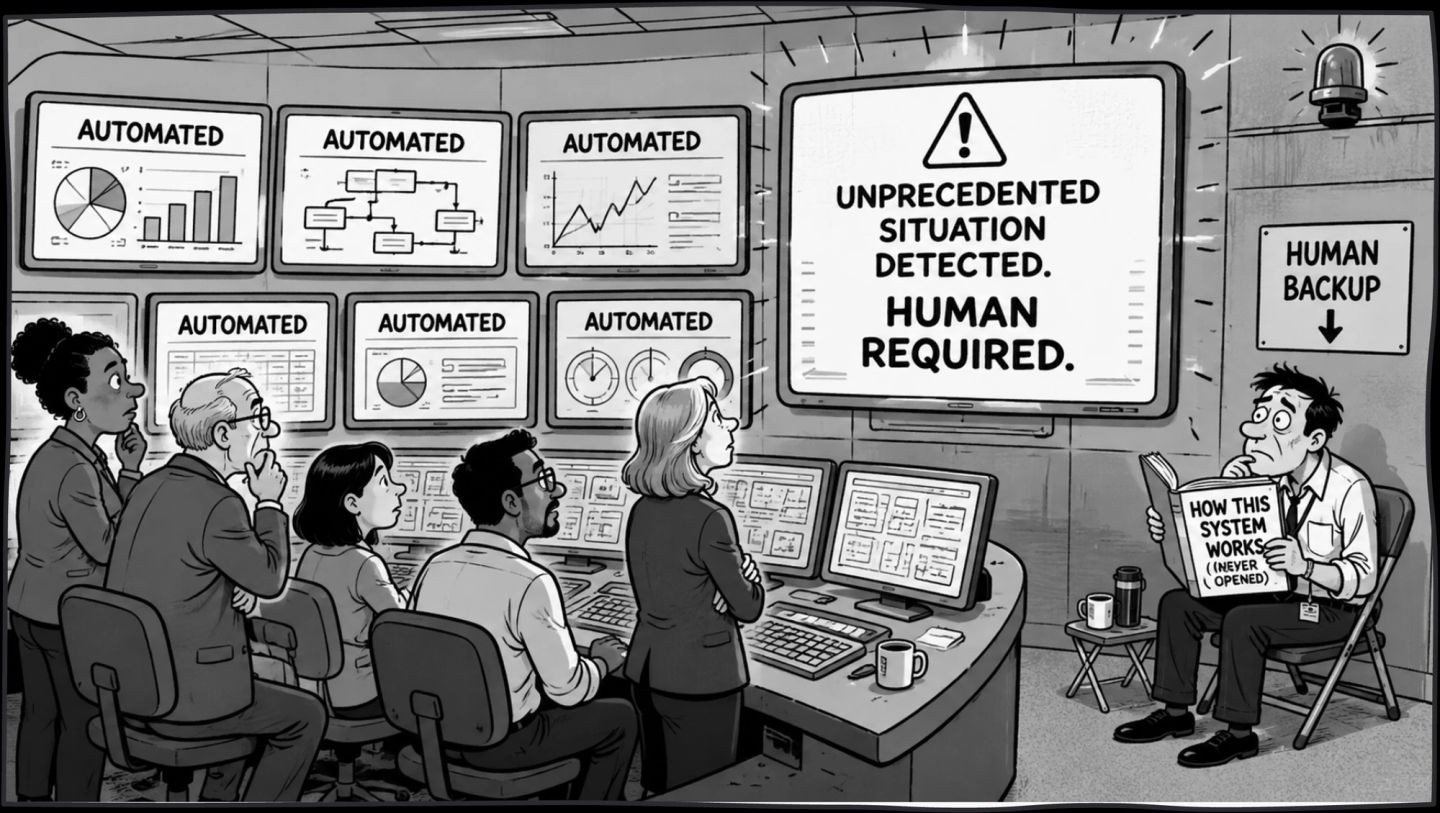
The automation trap: why your AI strategy is failing
The automations had already failed. In March 1979, the reactor core at the highly automated Three Mile Island nuclear plant was in the middle of a partial meltdown. The automation systems were not designed to support human adaptability. They were built to replace it.
For example, rather than showing a clear path to safety, the system buried the workers under an avalanche of 1,200 different alarms in a matter of minutes1. For months, these operators had been "out of the loop". They became passive observers of a system that handled tactical work perfectly. Because the technology handled the daily work, the humans had lost their "feel" for the system. They lacked the situational awareness to diagnose the crisis. They weren't experts anymore. They were just overwhelmed monitors. And of course, the 1,200 alarms didn't help.
To understand this failure, we must distinguish between two types of work. Tactical performance is the ability to follow a process or execute a plan reliably. Adaptive performance is the ability to diverge from that plan when things go wrong or context shifts. These are definitional opposites: the more a system is optimized for tactical consistency, the harder it becomes for the people in the loop to be adaptive.
This is the reality of Bainbridge’s Ironies of Automation. Companies build systems to eliminate human error by starting with the tactical tasks. But when they automate the tactical, companies often make the adaptive parts much more difficult. Automation engineers often view humans as the "weakest link" or a "leftover" component. This perspective, coupled with substandard training and tooling, ensures that people become less adaptive just when their judgment is most needed.
The language of AI transformation in many companies today has fixated on Automation. In just the past month, I've heard multiple C-suite leaders use "Stages of Automation" frameworks, borrowed from the world of autonomous vehicles, to describe their own AI goals.
This is a mistake. If you treat your best experts as backups to a machine, they will fail when the machine hits its limit. Rather than focusing on the stages of automation, you must focus on the stages of augmentation.
The allure of automation
"We replaced 40 people with an AI system" is a boardroom headline. "We made the remaining 1,000 people 10% more effective" is a footnote—despite being a higher return on investment.
For a performance-driven leader, the dream of full automation is a powerful drug. It promises the ultimate efficiency: set the system, walk away, and let the machine deliver the results. No salaries, no bottlenecks, and—theoretically—no human error. This "set it and forget it" wish has led companies to co-opt the SAE Levels of Driving Automation to describe their own AI transformations2:
- Level 1 (Driver Assistance): AI helps with one specific task (e.g., adaptive cruise control in driving or autocomplete in an email).
- Level 2 (Partial Automation): AI handles a sequence of tasks, but the human supervises every step (e.g., simultaneous lane-centering and braking in driving, or an AI workflow that drafts a report section-by-section with human approval at each step).
- Level 3 (Conditional Automation): AI "drives" the process, but the human must be ready to intervene at any moment (e.g., automated highway driving that requires a human fallback, or an AI research agent that requires a human to be on standby to resolve real-time ambiguities).
- Level 4 (High Automation): AI handles everything within a specific, "geofenced" workflow (e.g., autonomous taxis restricted to a specific city, or an AI system that fully automates processing for a specific category of customer support tickets).
- Level 5 (Full Automation): The system performs all work in all conditions with no human required (e.g., a car with no steering wheel that can go anywhere, or a fully autonomous AI business that operates without human intervention).
These levels work for cars because driving is a bounded, physical task. Knowledge work is the opposite. It is defined by ambiguity, shifting context, and subjective judgment. When you try to force the "Level 5" autonomous vehicle model onto a marketing or sales team, the logic breaks.
| Dimension | Automotive Automation | Knowledge Work Augmentation |
|---|---|---|
| Environment | Strictly bounded (roads, traffic laws). | Unbounded and ambiguous context. |
| Goals and outcomes | Static objectives (stay in the lane, don't hit the car). | Subjective and evolving objectives (is this strategy good?). |
| Failure mode | Immediate and visible (a crash). | Subtle and delayed (is this a good sales pitch?). |
| Human role | Backup monitor (passive). | Strategic orchestrator (active). |
| Humans involved | One if any. | Teams. |
The data shows that chasing full automation in knowledge work backfires. A study from Stanford and Carnegie Mellon Universities found that attempting to automate entire long-horizon tasks actually slowed work by 17.7%3. This loss is driven by a hidden Verification tax—the burden of auditing AI outputs for subtle errors or "fabrications." This verification work is demotivating for most. It turns experts into low-level editors, resulting in worse adaptive performance and higher talent turnover.
Even when the AI seems to work, "one-shotting" tasks—using AI as a shortcut rather than a collaborator—ambiguously may or may not result in a better outcome.
In a study of generative AI use in lesson planning, users who treated the AI as a static delivery mechanism exerted 25% more effort in terms of busywork actions, yet produced 10% lower quality results than those with an iterative mindset4. The allure of the easy button often leaves leaders with a workforce that is working harder, producing less, and losing the very skills they need to handle the adaptive work.
The four stages of augmentation: a new roadmap for human-AI synergy
If automation is about getting humans out of the way, augmentation is about putting them at the center of a much bigger machine. We must shift from viewing people as "backups" to viewing them as orchestrators in the middle.

This shift happens in four distinct stages, moving from individual tools to collective, continuously improving systems.
- Stage 1: AI-based learning and editing. This is the individual "learning" phase. One-shotting deliverables with a prompt or using it like Google is just the beginning. This is about collaborating with an AI to shape a deliverable. The person should always feel in control. This is cooking, not microwaving.
- Stage 2: AI workflows and agents. Here, individuals build and use "flows." They delegate readily programmable steps to agents while maintaining real-time oversight. The flows are thoughtfully designed to pull in humans at interim steps where their judgement is needed."
- Stage 3: AI strategizing and leadership. The focus shifts to the collective. Teams use AI to simulate strategies and stress-test ideas. Teams and whole organizations share the same AI context, memory, and prompts. As a result, this stage is highly collaborative and requires people to have critical collaborative skills.
- Stage 4: Continuously improving AI factories. AI factories are where teams and AI work together to create deliverables. They require commonly shared context and workflows that can be continuously improved by anyone using the factory. By doing so, companies are building assets that exhibit compounding continuous improvement. Companies that achieve this will create significant operational moats.
Moving through these stages isn't a technical project; it's a leadership curriculum. It requires a Learning Lab approach—a "CrossFit-style" environment where teams simultaneously build their technical AI skills and their collaborative problem-solving muscles.
The human change is the hard part
Shifting your technical architecture is easy compared to shifting your cultural mindset. This is why 95% of enterprise AI pilots are currently failing5. They focus on automation tools while ignoring the learning gap and motivation gap in the organization.
To win, you must stop treating your people like backups for a machine. Instead, double down on human capital with AI augmentation:
| AI Augmentation focus | AI Automation focus | |
|---|---|---|
| Significant ROI Realized | ~100% of an organization gains 5 to 20% productivity. 1-year payback period. | 2–4 year payback period. Pockets of impact. |
| Project success outlook | Nearly 100% when focused on the stages of augmentation. | Only ~5% success rate now. 40% predicted cancellation by 2028. Companies become littered with demoware and tech debt. |
| Core requirement | Teams in the loop. Context governance. Learning Labs to grow human skill and mindset. | Clean data foundations. Tightly defined use cases. |
The path to Stage 4 maturity requires two immediate actions.
First, perform a diagnostic assessment of your current AI initiatives. Are you inadvertently building black boxes that erode your team's expertise?
Second, invest in AI mindset and Skills that advance through the stages of augmentation. This isn't a one-day workshop on prompt engineering. It is a long-term Learning Lab—think of it as brain CrossFit—where your team builds the iterative, reflective habits needed to orchestrate complex systems.
To give you a sense of what this looks like, Vega Factor's Learning Labs structure the curriculum and skills like this:
- Stage 1: AI-based learning and editing
- Delegation
- Critical thinking
- Empowerment
- Stage 2: AI agents and flows
- Knowledge process design
- Context management
- Work architecture
- Stage 3: AI strategy to execution
- Strategy setting
- Planning and problem solving
- Building performance culture
- Apprenticeship and coaching
- Stage 4: AI factories
- Continuous improvement
- Process management
The future isn't about the machine doing the work for you. It's about you mastering the mindsets and skills to drive a much more powerful machine. Contact us for a diagnostic discussion or to learn how our Learning Labs can turn your workforce into an AI-native, people-first growth engine.
About the authors
Lindsay McGregor
Meet Lindsay McGregor, the best-selling co-author of Primed to Perform, and co-founder of Factor.ai and Vega Factor. She's on a mission to build organizations that are AI Native & People First, because, let's be honest, who wouldn't want a world where every company thrives and everyone genuinely loves their career?
Lindsay is a hard-working nerd at heart. She holds an MBA from Harvard Business School and an undergraduate degree from Princeton University. A former McKinsey & Company consultant, she's also a New York City Library cardholder and a science fiction enthusiast.
Today, Lindsay isn't just talking about change; she's making the tools and doing the science needed to ensure everybody has great professional lives. It's safe to say, she's making work work better for everyone.
Neel Doshi
Meet Neel Doshi, the best-selling co-author of Primed to Perform, and co-founder of Factor.ai and Vega Factor. He's dedicated his career to a pretty ambitious goal: creating a future where all companies are high-performing because they're AI Native & People First. Think of it as making work so good, people actually look forward to Mondays.
Neel looks at this challenge through the eyes of an engineer. He earned his engineering degree from MIT and his MBA from the Wharton School. A former Partner at McKinsey & Company, he's also a Kentucky Colonel and a graduate of the Bronx High School of Science. Neel takes science-nerd to all new heights.
Currently, Neel is focused on showing the world that through science and AI, every team and company can be extremely motivating and high-performing. No one need be left behind in the march of progress.
Published June 2, 2026
- ^President's Commission on the Accident at Three Mile Island. (1979). The Need for Change: The Legacy of TMI. Also cited in Sheridan, T. B. (1980). Computer control and human alienation. Technology Review, 83(1).
- ^SAE International. (2021). Taxonomy and Definitions for Terms Related to On-Road Motor Vehicle Automated Driving Systems (J3016_202104).
- ^Wang, Z. Z., et al. (2025). How Do AI Agents Do Human Work? Comparing AI and Human Workflows Across Diverse Occupations. arXiv preprint arXiv:2510.22780v1.
- ^Tran, P. T. H., et al. (2026). Preparing preservice teachers for generative AI in lesson planning: a process mining study of AI mindset and tool-only training. Journal of Digital Learning in Teacher Education, 42(1), 16-32
- ^MIT NANDA Initiative. (2025). The GenAI Roadmap: Navigating the Divide between Strategy and Performance.