Total motivation (or “tomo”) is a measure of motivation. It has been rigorously proven to predict not only individual health and happiness, but also team and organizational performance. Culture Checks measure how you’re feeling about your future work, so that your team can make the necessary adjustments now. Tomo should not be used to judge or evaluate teams or leaders. Achieving a certain level of total motivation should not be a company-wide OKR, as it is counterproductive to create pressure for achieving a certain level. Instead, you should be honest, constructive, and action-oriented.

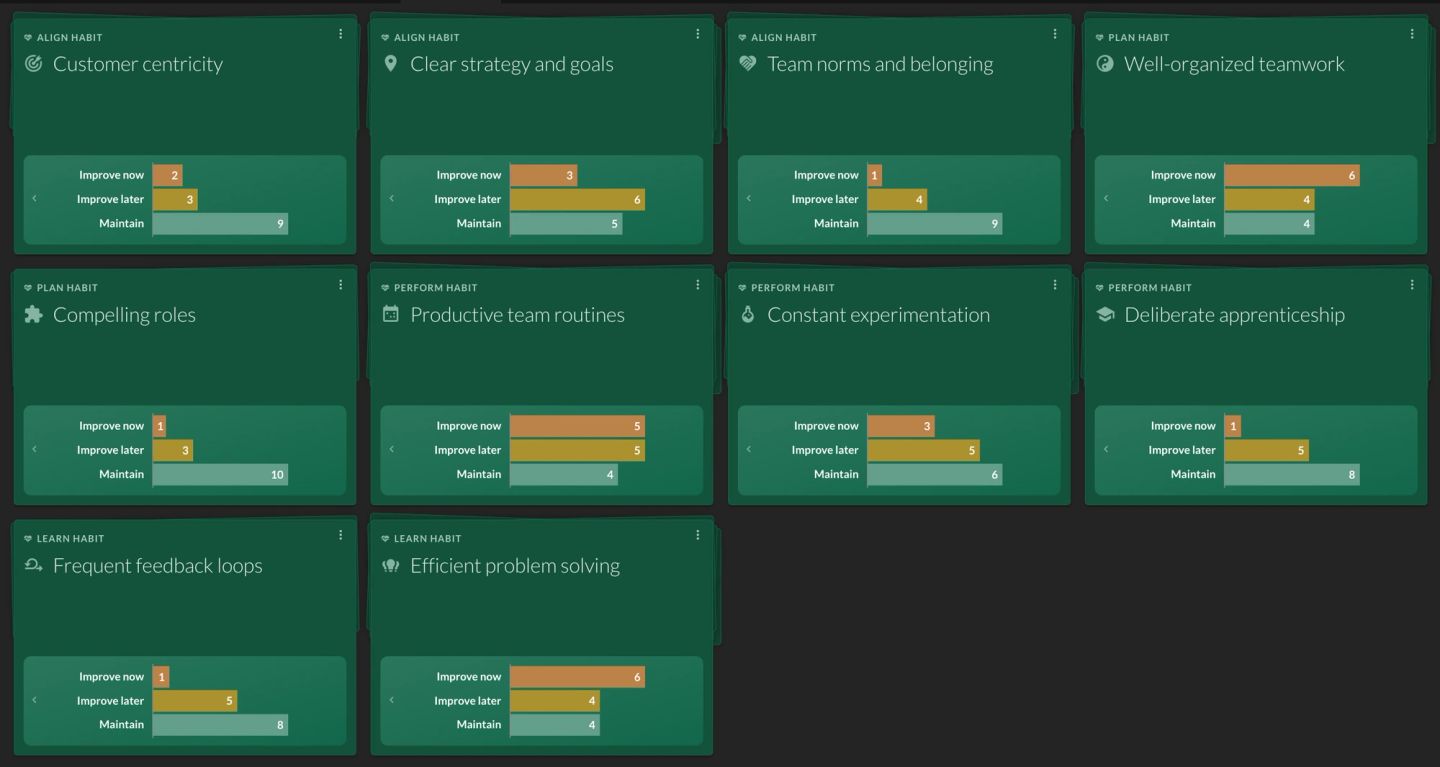
The Culture Checks also ask questions about the top eight habits a team can use to improve its motivation and performance. Motivation is your fuel gauge and habits are your engine.

How is total motivation calculated?
To measure total motivation, the survey asks about the six motives that drive behavior. When it comes to increasing performance, play is twice as powerful as purpose, which is in turn about twice as powerful as potential; conversely, when it comes to reducing performance, inertia is twice as destructive as economic pressure, which is about twice as destructive as emotional pressure. Therefore, the motives are weighted based on how much they impact outcomes. The formula is:

How can I teach my team about total motivation?
You can teach your team a lot about tomo in a short amount of time. Some quick resources with big impact include this Harvard Business Review article, this short video, and this podcast. To really dig in, the most comprehensive resource is the New York Times bestselling book Primed to Perform.